

When one burns one's bridges, what a very nice fire it makes.
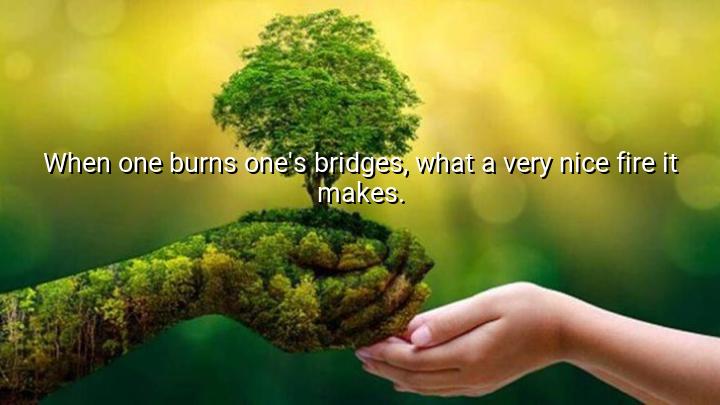




The quote by Dylan Thomas — "When one burns one's bridges, what a very nice fire it makes." — uses the metaphor of burning bridges to convey the idea of severing ties or eliminating options that once existed. To "burn a bridge" means to destroy a relationship or opportunity in a way that makes it impossible to go back. Thomas, however, adds an ironic twist by describing the process as creating a "very nice fire," suggesting that while burning bridges is destructive, it can also bring a sense of satisfaction or release in the moment.
Thomas's use of the word fire highlights the intensity and drama that often accompany actions of finality. The phrase suggests that burning bridges may feel like a dramatic, cathartic act, and the fire represents the emotional heat of cutting ties. However, the quote also invites reflection on the consequences of such actions. While the fire may feel good temporarily, it can leave destruction in its wake, making it impossible to rebuild what was lost.
In a broader sense, the quote can be seen as a commentary on impulsive decision-making. Burning bridges is often done in moments of anger, frustration, or determination, but Thomas’s words remind us that such actions, while satisfying in the short term, may come with long-term consequences. The fire of destruction is easy to create, but the aftermath can be hard to undo. This captures the tension between the fleeting satisfaction of letting go and the permanent nature of the choices we make.
Ultimately, Thomas's quote reflects on the human tendency to act in moments of emotion and finality, and it encourages consideration of the long-term effects of cutting off opportunities or relationships. The "nice fire" might be tempting, but it often leads to irreversible change, leaving us to evaluate whether the burning was worth the cost.

TTBich Lanh Tran Thi
The idea of a ‘nice fire’ from burning bridges evokes both warmth and destruction. How does this balance between creation and destruction play out in our lives? Can the act of burning bridges be both a creative force and a source of loss? I’d be interested in examples of when burning bridges led to positive transformation versus when it caused unforeseen difficulties.
This quote invites reflection on the double-edged nature of burning bridges. While it can symbolize freedom and a fresh start, it also cuts off safety nets. How do different personalities approach this—are some more prone to dramatic endings than others? It makes me wonder if society values forgiveness and connection too highly, sometimes discouraging necessary endings.
DNDuy Nguyen
Thomas’s imagery is powerful and a bit dark, suggesting that burning bridges is not just an act of ending but one of transformation. Could this be about embracing change with passion, even if it means losing old supports? I’d like to consider how this metaphor applies to personal relationships, careers, or social movements where severing ties can be a form of reclaiming agency.
TNTuyen Ngo
Reading this, I’m reminded of how people sometimes deliberately close doors behind them to move forward fully. But the phrase ‘nice fire’ also implies danger and finality. What are the emotional or psychological effects of burning bridges—does it bring relief, regret, or both? How do we decide when it’s worth igniting such a fire, knowing it might leave us isolated?
CTCuc Tran
This quote seems to celebrate the destructive beauty of burning bridges, which is quite provocative. Does Thomas suggest that destroying connections can be satisfying or empowering? How do we balance the appeal of dramatic endings with the practical need for reconciliation or future opportunities? I’m interested in hearing thoughts on when it might be justified or even beneficial to ‘burn bridges.’