

Do not go gentle into that good night but rage, rage against the dying of the light.
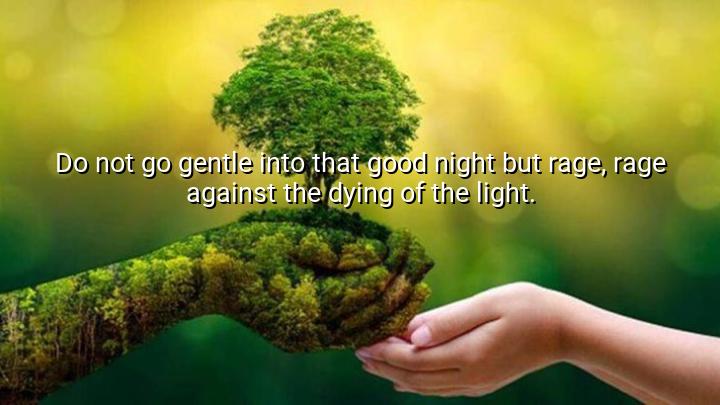




The quote "**Do not go gentle into that good night but rage, rage against the dying of the light," by Dylan Thomas, is a powerful call to resist the inevitability of death. The phrase "go gentle" suggests passing away quietly and without struggle, while "rage" represents the fierce resistance to death and the decline of life. Thomas encourages us to fight against the end of life with all our energy, rather than surrendering meekly to it. The "dying of the light" symbolizes the fading of life, the waning of vitality, and the approaching end of existence.
Written in his famous poem "Do Not Go Gentle into That Good Night," Thomas crafted this line for his dying father. His poem captures the intensity of grief and anger that arises when faced with the loss of a loved one. The repeated line, "rage, rage," emphasizes the depth of this resistance, urging both the person approaching death and their loved ones to fight against the inevitable with everything they have.
The quote reflects the human struggle against the unknown and often unwelcome nature of death. Thomas's insistence on raging against the dying of the light speaks to the inherent human desire to preserve life and to leave a meaningful mark on the world, even in the face of mortality. The emotion in his words serves as a universal plea for vibrancy and purpose, even at the end of life.
Ultimately, Thomas's words suggest that, while death is inevitable, one should resist it with strength, passion, and defiance. His message encourages us to live life fully, with as much intensity as possible, until the very end. The quote has since become an enduring symbol of fighting for life, no matter how much time we have left.

MPMit Phuong
The idea of raging against the dying light makes me think about the inherent tension between life and death. Does it suggest that we should resist death to the very end, or is it more of a metaphor for living fully, even when faced with mortality? Can the ‘rage’ against death be seen as a celebration of life, or does it imply a refusal to let go of something that naturally fades with time?
MQNguyen minh quan
Thomas’ call to fight against the dying of the light is filled with passion, but does it resonate with everyone? For some, facing death with calmness and acceptance can be just as brave as fighting against it. Shouldn’t the way we approach death be personal? How does one’s cultural or spiritual background influence whether they see death as something to fight or something to embrace?
MAvan ngoc minh anh
While Thomas’ quote is stirring, I wonder if it encourages an unhealthy attitude towards aging and death. Shouldn’t we be able to accept death when the time comes, instead of trying to fight it until the end? Is the idea of raging against death something that helps us live more fully, or does it create unnecessary pressure to ‘defeat’ something we ultimately cannot control? How do we approach death with grace while still living life to its fullest?
LDLinh Dang
Dylan Thomas’ words seem to glorify the struggle against death, but can this mindset be helpful for everyone? Does it imply that surrendering to death means failing to live fully? For those with terminal illness or in great pain, the fight against death might be exhausting. Can this ‘rage’ bring peace, or does it just prolong suffering? How do we balance the idea of fighting death with the need for acceptance?
MTminh tranduc
This quote is intense and evokes a strong emotional reaction. It makes me question: is the refusal to accept death a sign of vitality and strength, or does it point to a fear of letting go? Do we need to fight against death, or should we learn to accept it as part of life? Can ‘raging’ against the dying light truly offer us anything more than resistance to the natural course of life?