

I shall allow no man to belittle my soul by making me hate him.
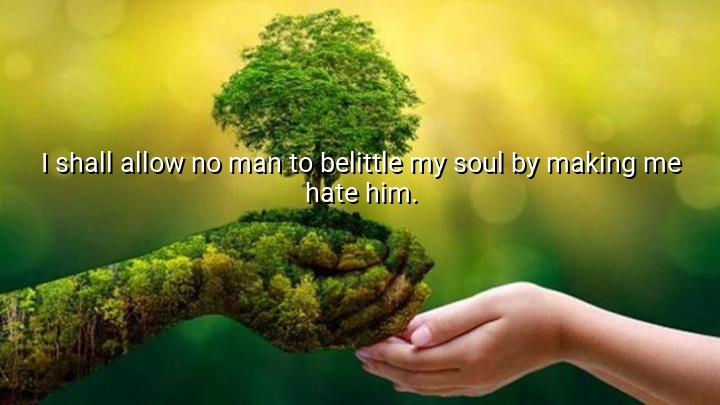




The quote by Booker T. Washington — "I shall allow no man to belittle my soul by making me hate him." — reflects his philosophy of maintaining inner strength and dignity despite the actions of others. Washington emphasizes that hatred is a destructive emotion, not only because it harms relationships but also because it undermines one's soul or inner peace. By choosing not to hate, he refuses to let others control his emotional state or diminish his character.
This quote is rooted in Washington’s values of self-respect and personal integrity. As an influential African American educator and leader, Washington advocated for a life of self-reliance and empowerment, encouraging people to rise above the prejudices and injustices they might face. He understood that hatred could lead to a loss of focus on one's goals and aspirations, and that letting go of such emotions was crucial for personal growth and success.
Washington's words also speak to his belief in forgiveness and non-resentment. Rather than allowing others to control his emotional response, he sought to maintain control over his own attitude and reactions. This stance is a form of emotional sovereignty, where an individual takes responsibility for their own peace of mind and well-being, regardless of the negativity or injustice they might encounter from others.
Ultimately, Washington's quote encourages us to rise above negative emotions such as hatred, which can cause us to lose our sense of self. Instead of allowing others to belittle us or dictate our emotions, we can preserve our integrity and continue to live with purpose and dignity. This perspective encourages inner strength and the ability to maintain focus on what truly matters in life.

MLLy Sa Ma Lay
I’m inspired by the quote’s affirmation of self-worth and autonomy over emotions. It makes me curious about historical examples where leaders or communities embodied this principle. How did refusing to hate contribute to their strength and effectiveness? Conversely, are there situations where confronting hatred head-on is necessary to prevent further harm?
DPFenn Dinh Phung
This statement seems to call for a kind of emotional sovereignty, where we decide what affects our inner self. But I wonder how this works in practice—can someone truly keep their soul intact in the face of sustained hatred or abuse? How might this idea be misinterpreted to encourage passivity or silence in the face of injustice?
HTHue Tran
Reading this, I think about the emotional labor involved in refusing to hate someone who harms us. Is this a form of self-care or a moral stance? What role does compassion play in this process—can we hate less if we understand more? It also makes me reflect on whether society encourages or discourages this kind of emotional discipline.
GDGold D.dragon
This quote highlights the resilience of the human spirit. It raises questions about the relationship between hate and power—does hatred give others power over us, or can it be a defense mechanism? How do we differentiate between healthy boundaries and suppressing natural emotional reactions? I’d like to explore how this idea has influenced social movements or personal healing journeys.
TTThuy Trang
I find this statement both empowering and challenging. It suggests that we have control over our emotional responses even when others try to demean us. But is it always realistic to avoid hatred, especially in cases of deep injustice or trauma? How might forgiveness or empathy fit into this philosophy? I’d be interested in hearing how others balance protecting their soul with the reality of strong negative feelings.