

We are never the same with others as when we are alone. We are different, even when we are in the dark with them.
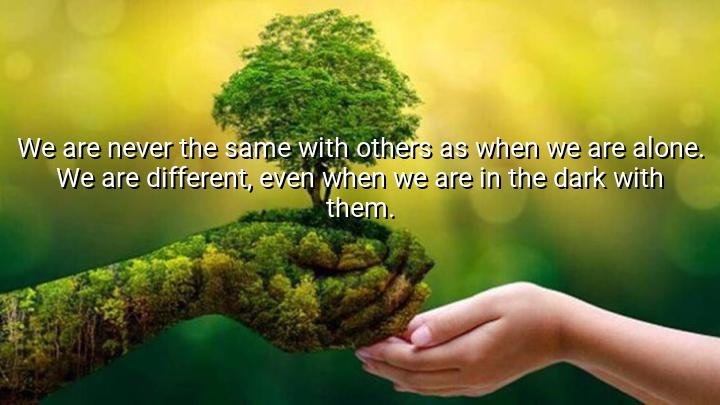




The quote "We are never the same with others as when we are alone. We are different, even when we are in the dark with them." by Maurice Maeterlinck reflects on the inherent differences in our behavior and personality when we are alone versus when we are in the company of others. Maeterlinck suggests that social interactions and the presence of others inevitably shape who we are, causing us to act differently. Even in situations where there is no clear visibility—"even when we are in the dark"—the social context influences how we present ourselves and how we behave.
The statement emphasizes the idea that self-awareness and authenticity are often altered in social situations. When alone, we are free to express ourselves without concern for social expectations or judgment, allowing us to be more in touch with our true selves. In contrast, being around others often requires us to adapt to external influences, adjusting our behavior to fit social norms, expectations, or the dynamics of the interaction.
Maeterlinck's words also point to the concept of identity and the fluidity of the self. Our identity is not static but is shaped by both our internal experiences and the external forces we interact with. This idea reflects the complex nature of human existence, where we are constantly shifting between different versions of ourselves based on our environment and the people around us.
The origin of this quote lies in Maurice Maeterlinck, a Belgian playwright, poet, and essayist, known for his works that delve into themes of human nature, isolation, and the unconscious. His exploration of individualism and the psychological aspects of social life is reflected in this quote, highlighting the tension between our solitary and social selves. Maeterlinck's insights into the complexities of human identity continue to resonate in both philosophical and literary discussions of personal and social dynamics.

TBHoang thao Bui
Maeterlinck’s observation raises questions about the nature of presence. Is it possible to truly share a moment or space with others without merging our inner worlds? How does this affect empathy and understanding in relationships? Could accepting that we are always somewhat separate deepen our appreciation for both individuality and connection?
TVThao Vuong
The reference to ‘in the dark’ adds a mysterious layer—does darkness symbolize vulnerability or unknown aspects of ourselves? How might darkness with others highlight emotional distance or unspoken tensions? Could this metaphor extend to situations where communication breaks down, making us feel ‘alone together’? How do we navigate those moments to foster genuine connection?
QTQuynh Trang
I’m intrigued by the paradox here: being with others but never quite the same as when alone. How do moments of solitude shape our identity compared to social interactions? Could this mean that our authentic selves are more accessible in isolation? How does this relate to concepts like introversion, privacy, or the need for personal space within community?
HPHa Phan
This quote prompts me to think about the complexities of human connection. How can we be physically close to others yet mentally or emotionally distant? What factors create that sense of being ‘different’ even when sharing intimate spaces? Does this challenge the assumption that proximity equals closeness, and how might we bridge that gap in relationships?
Hhaahthu
Maeterlinck’s idea that we are different even when alone with others, especially in the dark, feels deeply psychological. Does this suggest that our true selves emerge only in solitude, or is it about the masks we wear in social settings? How much do circumstances like darkness or silence amplify the sense of individual isolation despite physical presence? Could this insight explain feelings of loneliness in crowded places?