

How one hates to think of oneself as alone. How one avoids it. It seems to imply rejection or unpopularity.
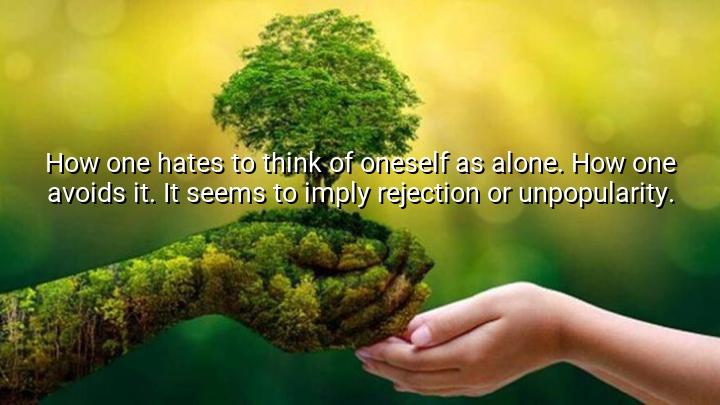




The quote by Anne Morrow Lindbergh — "How one hates to think of oneself as alone. How one avoids it. It seems to imply rejection or unpopularity." — touches deeply on the human fear of isolation. Being alone often carries negative connotations in our society, where connection and belonging are highly valued. Lindbergh captures the inner struggle many face when confronting solitude, suggesting that aloneness is not just a state of being but something emotionally charged and often misunderstood.
This quote likely comes from her reflections in "Gift from the Sea" (1955), a book where Lindbergh explores the need for introspection, solitude, and inner peace, especially for women balancing family, identity, and societal expectations. Despite advocating for solitude, she acknowledges the discomfort it can bring — the instinctive avoidance of being alone stems from the fear that it signals being unwanted, unloved, or socially rejected.
Lindbergh’s insight reveals how deeply social validation influences our self-worth. We are conditioned to associate popularity with success and rejection with failure, so the absence of others can feel like a personal flaw. The quote gently exposes the vulnerability that arises when we equate being alone with being less valued.
However, there is an underlying challenge in her words — to rethink our view of solitude

GGGhcdgf Gfhff
This quote highlights the emotional weight of solitude and the stigma surrounding it. How can individuals learn to reframe ‘being alone’ not as rejection but as an opportunity for growth? What practical steps or mindsets help people become comfortable with solitude? I’m also curious how this fear of being alone affects mental health and social dynamics in our increasingly interconnected world.
KQTo Kim Quyen
Reading this makes me question how much of our fear of being alone is socially constructed versus innate. Is it possible that the negative connotations around aloneness are culturally specific? How do different cultures and philosophies view solitude and loneliness? I’d be interested in exploring how embracing aloneness can be a form of self-care and empowerment rather than a sign of rejection.
THNguyen The Hai
The quote reveals how much discomfort people feel about the idea of being alone, linking it to rejection. I wonder how this fear influences our behaviors—do we cling to unhealthy relationships simply to avoid being alone? What role do social media and constant connectivity play in shaping our aversion to solitude? Could learning to accept aloneness lead to greater authenticity and resilience?
GNGiang ne
This statement prompts me to think about the difference between loneliness and solitude. How do we distinguish between the negative feeling of rejection and the neutral or even positive state of being alone? Does society fail to teach us how to be comfortable alone? I’d be interested in perspectives on how embracing solitude might change our emotional well-being and interpersonal relationships.
CVChinh Vu
Anne Morrow Lindbergh’s reflection points to a painful truth about self-perception and social connection. Why do we avoid thinking of ourselves as alone? Is it because being alone threatens our identity or self-worth? I wonder if this avoidance sometimes prevents people from exploring the deeper benefits of solitude, like self-discovery and peace. How can we shift cultural attitudes to reduce the shame associated with aloneness?