

To be adult is to be alone.
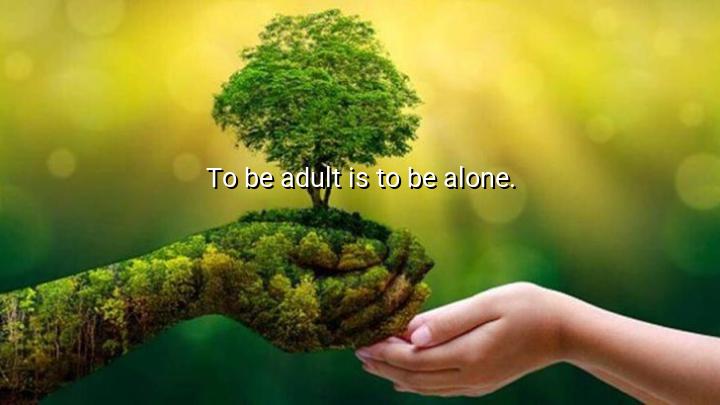




Jean Rostand’s quote, "To be adult is to be alone," speaks to the solitude and self-reliance that often comes with adulthood. Rostand suggests that adulthood involves taking on responsibility, making decisions, and facing the complexities of life independently, which can lead to a sense of isolation. The quote implies that, unlike childhood, where individuals are often surrounded by family or community support, adulthood requires individuals to navigate life on their own terms, and this often means being alone in their thoughts and actions.
The origin of the quote lies in Rostand's perspective on the maturity and freedom that comes with adulthood. While childhood is often characterized by dependency and external influences, adulthood forces individuals to take charge of their lives and embrace their personal choices. This transition can feel isolating, as the comfort of others' guidance or protection may fade, and individuals must rely on their own judgment and abilities.
Rostand’s statement also suggests that self-awareness and independence are key aspects of being an adult. In many ways, adulthood involves learning to cope with life’s challenges without depending on others for answers or support. The quote reflects the idea that true maturity is found in the ability to stand alone, make difficult decisions, and face the consequences of those decisions.
Ultimately, Rostand’s quote highlights the internal journey that comes with growing up. Adulthood often brings a sense of responsibility and solitude, as individuals are forced to live with the results of their actions and choices. It reflects the complexity of adulthood, where independence is both a source of strength and, at times, loneliness.

KKVH
Jean Rostand’s quote hits hard, especially in moments when adulthood feels isolating. But I wonder—do we create our own isolation by assuming adulthood means independence at all costs? Is it possible that real maturity involves not just accepting solitude, but also seeking out interdependence and emotional intimacy in a new, more grounded way?
HTHuong To
There’s a haunting beauty to this idea, and yet I question its finality. Can’t adulthood also be about choosing meaningful companionships instead of being passively surrounded by people? Does growing up mean letting go of the illusion that others can save us—or does it mean learning to share life’s weight with someone else in a conscious, mature way?
NPchi nguyen phuong
I can’t decide if this quote is deeply profound or just incredibly bleak. Is it saying that emotional self-reliance is part of growing up, or that connection becomes harder as we age? Why do so many adults report feelings of isolation, even when surrounded by people? Maybe it’s less about physical aloneness and more about internal burdens no one else sees.
MKNguyen Minh Khang
It’s a powerful statement, but is it universally true? I know adults who feel more connected than ever—through relationships, community, and purpose. Does this quote speak more to existential solitude than literal loneliness? And if so, is that solitude something we should resist, or embrace as a deeper aspect of maturity?
P<Panhh <3
This quote feels brutally honest in a way that’s both sobering and strangely comforting. Is adulthood inherently lonely because of the weight of responsibility, or is it more about the realization that no one else can fully live your life for you? I wonder if this aloneness is a bad thing—or is it simply the price of self-awareness and independence?