

All men's miseries derive from not being able to sit in a quiet room alone.
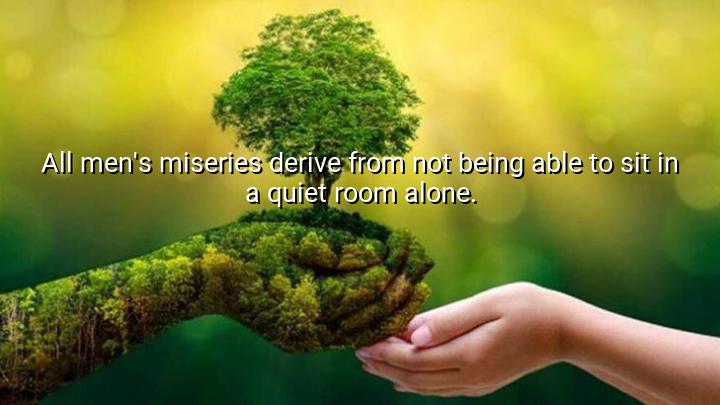




Blaise Pascal’s quote, "All men’s miseries derive from not being able to sit in a quiet room alone," reflects his philosophical view on the inner struggles and dissatisfaction that arise from the inability to be at peace with oneself. Pascal suggests that many of life's miseries and emotional turmoil stem from the human inability to embrace solitude and engage in quiet reflection. In this context, he proposes that people often seek external distractions—whether through activities, social interaction, or material possessions—to avoid confronting their own thoughts and feelings.
The origin of this quote lies in Pascal’s work, particularly in his famous work, Pensées, where he delves into themes of existentialism, human nature, and the quest for meaning. Pascal believed that much of human suffering comes from a disconnection with self-awareness and the discomfort of being alone with one’s thoughts. In a world filled with constant distractions and noise, the ability to sit silently in a room and reflect on one's life and purpose was a rare and often difficult task.
Pascal’s quote speaks to the difficulty of embracing solitude in an age where busyness is often glorified. He argues that the avoidance of being alone with one’s thoughts prevents people from truly understanding themselves or addressing deeper existential concerns. Instead, people fill their lives with noise and activity to escape uncomfortable feelings and the inevitability of self-exploration.
Ultimately, Pascal’s quote challenges the modern obsession with constant activity and external validation. It suggests that true contentment and understanding come from embracing solitude and the quiet reflection it brings. By learning to be at peace with ourselves in moments of silence, we can better confront our inner struggles and find deeper meaning in life.

A9Do Mai Anh 9A
I appreciate the philosophical weight of this quote, but I also feel conflicted. Not everyone has the same relationship with solitude—what about people who live with trauma or mental illness, for whom being alone in silence might actually amplify suffering? Could Pascal’s insight be more about mindfulness than literal isolation? Maybe it's not about being alone, but being undistracted and present with oneself.
NNSo Nak Nam
There’s a real paradox here. Humans are social beings, yet Pascal implies that peace comes from isolation. Does this suggest that true self-awareness or clarity can only be achieved without external influence? If so, how do we balance that need for solitude with the reality that relationships are also central to a fulfilling life?
HNHoai Nam
This idea feels especially relevant today, when constant connectivity leaves little space for silence. I wonder, are we avoiding stillness because we’re afraid of what we might find when we stop moving? Do our thoughts become too loud when the world gets quiet? If learning to sit alone is so essential, why is it so hard for so many of us to actually do it?
UGUser Google
I find Pascal’s perspective both brilliant and a bit unsettling. It makes me wonder: is it really possible for most people to feel content in silence, or are we biologically wired to seek connection, movement, stimulation? What would it take—emotionally, mentally—to be at peace alone in a quiet room? And is that something we should all actively practice, like a kind of spiritual hygiene?
BLBao Long
This quote makes me think about how uncomfortable stillness has become in our modern lives. Is the inability to sit alone in silence really the root of so much misery, or is it a symptom of deeper emotional restlessness and anxiety? Maybe Pascal was pointing to something timeless—our need to constantly distract ourselves from ourselves. But can solitude truly be healing for everyone, or is it a luxury only some can afford?