

Alone we can do so little; together we can do so much.
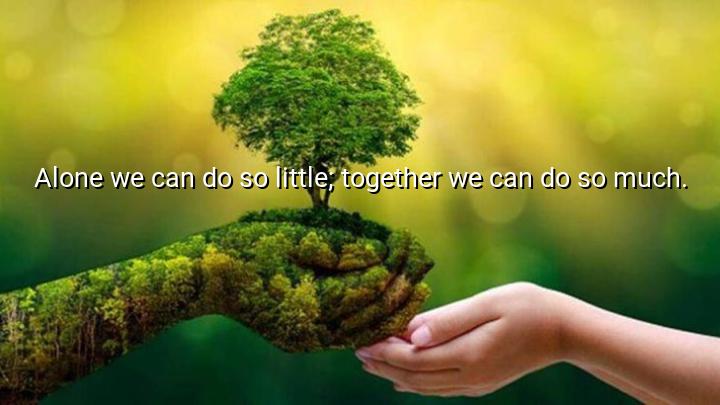




Helen Keller’s quote, "Alone we can do so little; together we can do so much," emphasizes the power of collaboration and unity. Keller suggests that individual efforts, while valuable, are limited in their impact. However, when people work together, they can accomplish far greater things than any single person could alone. This speaks to the idea that community, whether in personal relationships, social movements, or professional settings, amplifies the potential for success and positive change.
The origin of this quote comes from Keller’s deep understanding of isolation and the value of human connection. As someone who faced the challenges of being both deaf and blind, Keller recognized firsthand the difficulty of accomplishing goals in isolation. She spent much of her life advocating for disability rights and the empowerment of others, showing that even those facing significant obstacles can achieve extraordinary things when they have the support and collaboration of others.
Keller’s words are also a reflection of the importance of teamwork and collective action in social and political movements. Whether in fighting for human rights, equality, or any cause, the collective power of individuals uniting for a common purpose can lead to lasting change. This highlights the strength that comes from shared goals and mutual support, which is often necessary to overcome societal challenges.
Ultimately, Keller’s quote reinforces the belief that individuals are capable of great things, but together, people have the power to make even more profound and meaningful changes. It is a reminder that collaboration, empathy, and working together are central to achieving not just personal goals, but also larger social and global objectives.

Nnhu
It’s incredible that Helen Keller—who overcame such profound challenges—spoke so emphatically about togetherness. Do you think her perspective reflects not just her life experience but a broader truth about human resilience? Maybe real progress, whether personal or societal, is always grounded in empathy and connection rather than lone ambition.
BBMua Bong Bong
This got me thinking about introverts and people who feel more effective working solo. Can collaboration be meaningful even for those who thrive in solitude? How do we balance the idea of 'togetherness' with honoring different work styles and personalities? Maybe the concept of unity needs to include diverse modes of contribution too.
TPPhung Thien Phuoc
I love how this quote invites reflection on the role of humility in success. If we accept that we can’t do everything alone, are we more open to learning, collaboration, and shared credit? Or do you think our fear of losing recognition makes it hard to fully embrace teamwork, especially in cultures that reward individualism?
Qquynh
Helen Keller’s quote resonates deeply, especially in times of crisis. During the pandemic, for instance, didn’t we all see how essential collective action is? But why does it take emergencies to highlight the importance of unity? Shouldn’t our default approach to solving problems—climate change, inequality, education—be rooted in community and cooperation rather than competition?
VTVinh Thanh
It’s such a simple yet profound statement. But I wonder—how do we truly build the kind of trust and shared vision necessary for meaningful collaboration? In workplaces or even in activism, egos, miscommunication, and fear of vulnerability often get in the way. What makes a group really 'work together' rather than just coexist while doing their own thing?