

The voice of the intelligence is drowned out by the roar of fear. It is ignored by the voice of desire. It is contradicted by the voice of shame. It is biased by hate and extinguished by anger. Most of all it is silenced by ignorance.
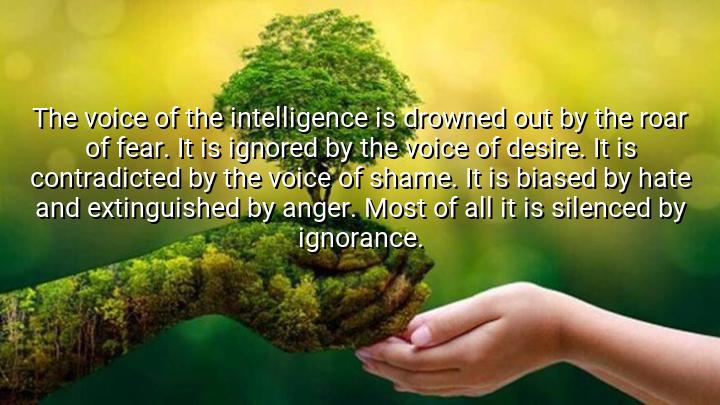




In this quote, Karl A. Menninger reflects on how the voice of intelligence is often overwhelmed and silenced by powerful emotions and forces within us. He identifies several forces that drown out reason, including fear, desire, shame, hate, anger, and most significantly, ignorance. These emotions and states of mind cloud our judgment, making it difficult for intelligence or rational thought to guide our actions. Menninger’s insight suggests that these internal conflicts can prevent us from making clear, thoughtful decisions.
Menninger’s statement highlights the battle between emotion and reason. Fear and desire push us to act impulsively, often bypassing logical thinking in favor of immediate gratification or avoidance. Similarly, shame and anger distort our perceptions, causing us to react defensively or destructively. The influence of hate can fuel irrational decisions, and ignorance prevents us from seeing things clearly, further erasing the voice of intelligence. Ultimately, these emotions create a barrier to self-awareness and thoughtful decision-making.
The origin of this quote lies in Menninger’s understanding of the complexities of the human psyche. As a prominent psychiatrist and author, Menninger often explored the psychological forces that shape human behavior. His work focused on the interplay between mental health, emotions, and rationality, recognizing that the human mind is often at odds with itself due to these conflicting emotions. This quote captures his belief in the importance of overcoming these forces to allow intelligence to guide us toward healthier, more balanced lives.
Ultimately, Menninger’s quote is a reminder that emotions can overpower reason, making it essential to recognize and manage them in order to think and act with clarity and wisdom. By addressing fear, desire, and other emotional responses, we can clear the path for more rational and intelligent decision-making, leading to a deeper understanding of ourselves and the world around us.

TFTOI THICH FA
This quote is a powerful reminder of the fragility of rational thought. It makes me wonder how often we let emotions and biases cloud our judgment without realizing it. How can we create dialogues or systems that prioritize intelligence and truth over emotional noise? Is there a danger in trying to suppress emotions too much in favor of intellect, or is this balance essential for progress?
LTLy Tran
The notion that intelligence is ‘silenced by ignorance’ is particularly striking. It makes me question how much ignorance is a personal failing versus a societal one. Are there ways to foster curiosity and openness to prevent ignorance from overpowering reason? This also brings up the importance of critical thinking skills—can they act as a shield against the ‘roar’ of fear and other destructive forces?
Nnguyentam
This quote points to a complex interplay between emotion and reason. I’m curious about how individuals can protect or amplify their intelligence when faced with these overpowering voices. Is mindfulness or self-awareness enough, or are structural changes needed in society? Also, does this suggest that emotions like anger and hate are always negative, or can they sometimes be channeled constructively?
LNDoan Le na
Reading this, I feel compelled to ask: is it possible to silence fear, desire, shame, hate, anger, and ignorance entirely, or is the challenge to balance them with intelligence? The quote paints a bleak picture, but does it also hint at the potential for overcoming these barriers? How do different cultures or societies handle this struggle between intelligence and emotional bias?
NVNguyen Van
I find this quote profoundly true but also quite discouraging. It highlights how many forces work against reason, making it difficult for intelligence to shine through. Does this mean that wisdom is often inaccessible to the average person? How do we cultivate environments or communities where intelligence isn’t drowned out? What role does education play in combating the silencing effects of ignorance and emotional turmoil?