

Hope is a necessity for normal life and the major weapon against the suicide impulse.
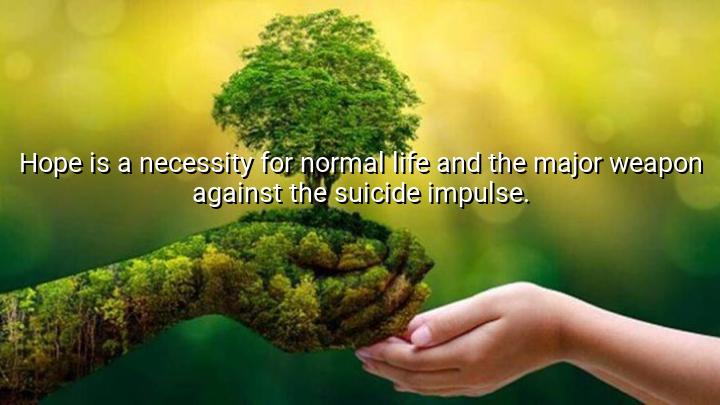




The quote "Hope is a necessity for normal life and the major weapon against the suicide impulse," by Karl A. Menninger, emphasizes the critical role that hope plays in maintaining mental health and well-being. Menninger, a renowned psychiatrist and founder of the Menninger Foundation, understood the deep connection between emotional well-being and psychological survival. In this quote, he asserts that hope is not just a comforting emotion but an essential force that helps individuals cope with life's challenges and maintain a sense of purpose.
Menninger highlights that hope serves as a protective mechanism against the most extreme psychological states, such as suicidal thoughts. When people feel trapped by despair, the presence of hope provides the strength to continue moving forward, offering a belief that things can improve. In this sense, hope becomes the antidote to the suicide impulse, giving individuals the resilience to endure suffering and hold on to the possibility of a better future.
The idea that hope is a necessity for normal life speaks to its foundational role in emotional and psychological functioning. Without hope, individuals may lose motivation and direction, leading to feelings of helplessness. Menninger’s words remind us that, much like physical needs, hope is a crucial element for mental survival, allowing people to navigate difficulties with a sense of purpose and belief in eventual recovery.
In essence, this quote reflects Menninger’s understanding of the mind’s need for optimism and anticipation of better days. He emphasizes that without hope, life can feel unbearable, but with it, people can endure and even thrive despite their challenges. This perspective has had a lasting influence on mental health, underscoring the profound connection between hope and psychological resilience.

AAdministratorAdministrator
Welcome, honored guests. Please leave a comment, we will respond soon