

The true art of memory is the art of attention.
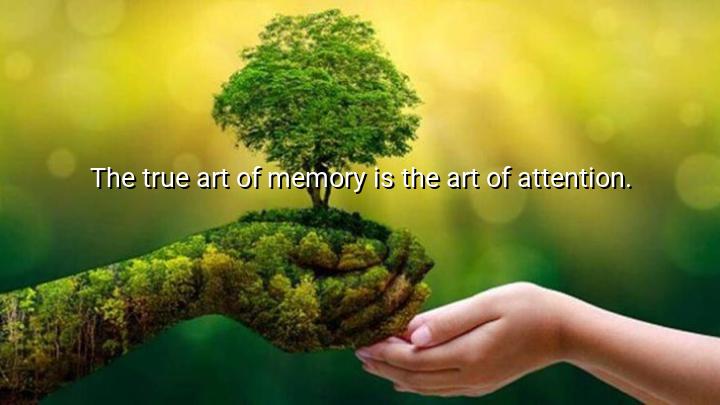




The quote "The true art of memory is the art of attention" by Samuel Johnson highlights the idea that memory is not simply about recalling information but about actively focusing and paying attention in the first place. Johnson, an English writer and lexicographer, suggests that effective memory is rooted in the way we engage with the world around us. Rather than relying solely on techniques for remembering, Johnson emphasizes the importance of being fully present and attentive to what we experience, as this attention forms the foundation of our memory.
In this context, attention is seen as a key element in creating lasting memories. When we truly focus on something, we are more likely to retain and recall it later. This makes the act of remembering less about passive recollection and more about active engagement with the present moment. Johnson’s view aligns with modern cognitive theories, which suggest that attention plays a critical role in how we encode and store memories.
The phrase "art of memory" also suggests that remembering is a skill that requires practice and intentionality. Memory is not just about passively receiving information but about making a conscious effort to engage with it in a meaningful way. In this sense, memory becomes a refined art, where careful attention transforms fleeting moments into lasting impressions.
Ultimately, Johnson’s quote emphasizes that memory is not a passive process but an active one that requires focus and awareness. By developing the art of attention, we can improve our ability to retain and recall information, making memory an intentional and skillful practice rather than something left to chance.

TKThom1 Kieu
There’s something deeply practical in this quote that I wish we talked about more in education. We push memorization techniques but rarely teach how to truly pay attention. What if the real skill students need is learning how to focus in a world that’s built to fragment their thoughts? This quote feels like a call to reimagine how we approach learning and memory altogether—not just as storage, but as presence.
LNlanthanh nguyen
I love how Johnson reduces something as complex as memory to a fundamental principle: attention. But it makes me wonder—what about people with neurological conditions like ADHD or trauma-related memory issues? Is attention still the core of memory in those cases, or do other factors override that link? It raises interesting questions about how biology and psychology intersect with this very philosophical idea.
TSCuc cuc troi song
This quote made me realize how often I blame myself for forgetting things, when maybe I never truly paid attention in the first place. It’s a humbling thought. I’m curious—do you think attention can be trained like a muscle? And if so, what are the best methods? Meditation? Focus exercises? It seems like mastering attention could improve not just memory, but learning, relationships, and overall quality of life.
MDPhung Minh Duc
Johnson’s insight feels especially relevant now, given how often our attention is split between screens, tasks, and conversations. Could it be that improving memory isn’t about more effort, but more presence? I’d love to hear thoughts on how technology, especially smartphones and constant notifications, might be damaging our ability to truly remember—not because we forget, but because we never fully paid attention to begin with.
UGUser Google
This quote really got me thinking about how much we overlook the role of attention in memory. In a world full of distractions and multitasking, is it any wonder our memories feel foggy or fragmented? I wonder if practicing mindfulness or focused observation could actually improve memory more effectively than just repeating information. Maybe we don’t have 'bad memory'—maybe we just don’t pay close enough attention in the first place.