

Poetry is the art of uniting pleasure with truth.
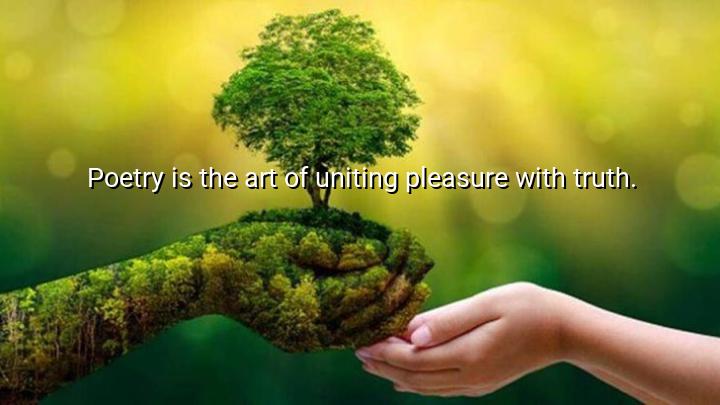




Samuel Johnson’s quote, “Poetry is the art of uniting pleasure with truth,” captures the essence of what he believed poetry should achieve: a balance between aesthetic enjoyment and intellectual or moral insight. Johnson, an 18th-century English writer, critic, and lexicographer, played a major role in shaping English literary standards. For him, the best poetry didn’t just entertain—it also revealed something meaningful about the human condition or the world.
The word “pleasure” refers to the emotional impact, rhythm, and beauty of language that poetry offers. It includes the delight found in imagery, sound, and the musicality of verse. But Johnson insists that this emotional response should not exist in a vacuum. True art—especially poetry—should also express or uncover truth, whether that truth is philosophical, moral, or universal.
Johnson’s ideal of uniting pleasure with truth reflects the Neoclassical values of his time, which emphasized reason, order, and moral purpose in literature. He believed that poetry should elevate the reader by providing insight while also being pleasing to the senses. In this way, it performs both an aesthetic and an educational function.
Ultimately, the quote reminds us that great poetry speaks to both the heart and the mind. It delights us through its craft, but it stays with us because it says something true about life. In blending these two elements, poetry becomes a powerful force for both enlightenment and enjoyment, fulfilling one of its highest purposes in Johnson’s view.

VGHo Viet Giang
This quote reminds me why I fell in love with poetry in the first place. There’s something deeply satisfying about encountering a poem that captures a truth you’ve always felt but never knew how to say, and doing it in a way that’s beautiful or surprising. But I’m curious—what happens when the truth itself is ugly? Can poetry still be pleasurable then, or does the art lie in making it bearable?
TONguyen Thi Oanh
It’s fascinating how Johnson pairs pleasure and truth as if they are natural companions in poetry. I often think about how different poets emphasize one over the other—some aim to delight, while others challenge and provoke. Is one approach more effective or lasting than the other? And do different cultures or periods in history tend to lean more toward one aspect of poetry than the other?
NY129-Vo Nhu Y-10A3
This quote raises an interesting point about the dual responsibility of poets: to reveal something real and to do it beautifully. But I’m torn—should poetry always aim to be pleasurable? Some of my favorite poems are raw and even unpleasant, but they linger because they’re honest. Does this quote risk reducing poetry to something too polished or agreeable? Or is the pleasure found in how deeply it resonates, even when it hurts?
1L13-Cam Ly-12A11
As a reader who turns to poetry for emotional insight, I resonate with this quote. But I also question whether all poetry needs to contain 'truth' in a literal or factual way. Is imaginative or fantastical poetry—like myths, surrealism, or nonsense verse—somehow less valuable? Or is the ‘truth’ Johnson mentions more about emotional authenticity than literal accuracy? I’d love to hear how others define poetic truth.
TTtuan tu
I really appreciate the elegance of this definition of poetry. It’s rare to see someone describe poetry as both enlightening and enjoyable. But I wonder how this definition applies to modern poetry, especially experimental forms that don’t prioritize beauty or traditional pleasure. Can a jarring or fragmented poem still fit this idea? Is the 'pleasure' sometimes just the stimulation of engaging with something challenging or unconventional?