

In Art, man reveals himself and not his objects.
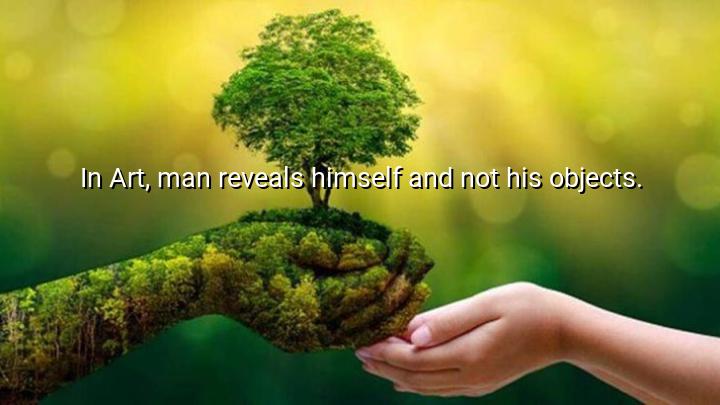




Rabindranath Tagore’s quote, “In Art, man reveals himself and not his objects,” emphasizes the deeply personal and expressive nature of art. Rather than focusing on the external world or simply depicting objects, art becomes a mirror through which the artist unveils his inner self—his emotions, thoughts, beliefs, and spirit. According to Tagore, the true power of art lies not in representation, but in revelation of the human soul.
As a Nobel Prize-winning poet, philosopher, and artist from India, Tagore believed strongly in the spiritual and emotional dimensions of creative expression. His work spanned literature, music, painting, and education, and this quote reflects his understanding of art as a universal language that transcends mere form or content. For Tagore, when a person creates, they project their inner world onto the canvas, page, or performance—not just the material surroundings.
The phrase “not his objects” points to a key distinction: art is not about copying or reproducing reality, but about interpreting it through the lens of the individual experience. A painting of a tree, for instance, is not just about the tree—it is about how the artist feels and thinks about that tree. This interpretation reveals much more about the creator than the subject itself.
Ultimately, Tagore’s insight elevates art as a form of self-discovery and human connection. Through art, we access the depths of the artist's mind and soul, and in doing so, perhaps recognize pieces of ourselves as well. His quote encourages us to look beyond the surface of an artwork and ask what it tells us about the person who created it.

HKHoan Kim
There’s something liberating in the idea that art is more about the self than the object. It removes the pressure to portray things 'accurately' and instead emphasizes emotional authenticity. But does this mean that viewers should focus more on what a work tells them about the artist than what it depicts? How do we balance appreciating a piece aesthetically while also engaging with its deeper personal layers?
DNtran thi dieu nguyen
This quote makes me think about whether all artists are comfortable with this level of exposure. If making art is always revealing, is that part of why so many creatives are hesitant to share their work? It’s not just about skill or technique—it’s about vulnerability. I wonder how many artists hide behind their subject matter, trying to deflect attention away from their personal truths.
QNHoang Thi Quynh Nhu
Tagore’s view makes me reflect on the deeply personal nature of creating art. It’s like the canvas or medium becomes a kind of diary, even when the subject is something seemingly unrelated—like a tree or a street. But I wonder, does this perspective undervalue the importance of the objects themselves? Can’t the choice of subject still carry symbolic weight or be a conscious commentary on something external?
GTLuu Gia Thoai
I’m curious how this quote applies to contemporary digital art or AI-generated works. If art is about self-revelation, can tools that rely on algorithms and vast datasets still be considered true 'art'? Is human intention the key to authentic expression, or can machines be vessels of indirect self-revelation through the artists who program or direct them? This makes me question what really qualifies as revealing oneself through creative output.
TVThai thuy van
I find Tagore’s statement fascinating, especially when thinking about art criticism. Should critics be analyzing the artist’s psychology more than the artwork’s subject matter? This idea that the artist reveals themselves, not their subjects, suggests that we might better understand a person through their creative choices than through direct conversation. But how far can we go with this interpretation without projecting our own biases onto their work?