

Errors are not in the art but in the artificers.
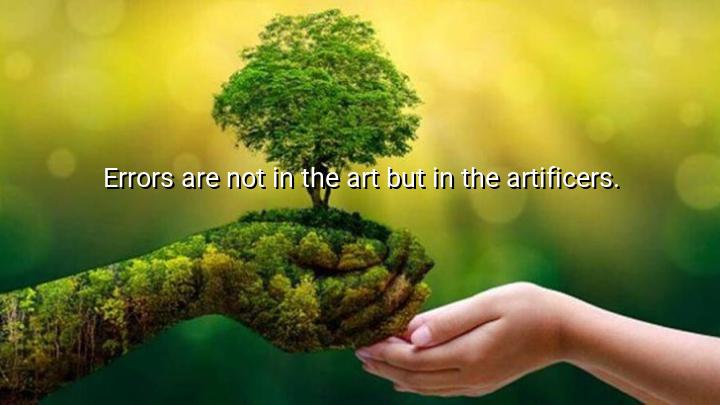




The quote "Errors are not in the art but in the artificers" by Isaac Newton reflects his view on the nature of knowledge, creativity, and human fallibility. The word "art" here refers not to visual art, but to the scientific or technical craft, the disciplined method or system being employed. By contrast, "artificers" refers to the practitioners, the human beings who apply or interpret that method. Newton is emphasizing that when things go wrong, it's usually due to human error, not because the underlying principles or systems are flawed.
This quote has its roots in Newton’s broader philosophy of natural philosophy and scientific inquiry. Newton believed that the universe operated on rational, discoverable principles. If mistakes occurred in interpretation or application, they were due to limitations in the observer, not in the natural laws themselves. In this way, the quote is both a critique of careless work and a defense of the rigor of the scientific method.
From a broader perspective, the quote underscores the idea of objectivity in systems and methods. The "art" — whether it be in mathematics, mechanics, or optics — remains pure and logical. It is the "artificers" — scientists, scholars, or artists — who may introduce errors through misunderstanding, misuse, or oversight. Newton’s humility and precision are evident here; he urges fellow scholars to be more diligent and self-critical rather than blaming the discipline itself.
Today, this insight is still widely applicable, especially in fields such as engineering, medicine, and technology. Blaming the tools or systems for failure often overlooks the more pressing issue: how we, as users or interpreters, engage with them. Newton’s quote is a timeless reminder that excellence lies in both the craft and the craftsman, but accountability rests with the latter.

BYBao Yen
This quote reminds me of the debate over the objectivity of truth in science versus the subjectivity of human interpretation. If the 'art' is pure, then are all misinterpretations or misuses the fault of the person applying it? That’s a big philosophical claim. It raises questions about intent, knowledge, and bias. Can we ever act without introducing error, or is human imperfection simply part of the process?
PTTran Mai Phuong Trinh
I wonder if Newton's perspective might discourage experimentation. If every error is attributed to the individual rather than the process or form, doesn’t that create pressure for perfection? It’s a high bar. Does that mean those who make frequent mistakes are simply less capable—or are they just pushing the limits more? I’d be curious how Newton saw the role of trial and error in learning and discovery.
KHLe Thi Kim Hue
I’m intrigued by how this statement draws attention to human accountability. It’s easy to say a method or artistic form failed, but maybe we need to take a closer look at our own execution. Still, is it always that clear-cut? Sometimes innovation comes from so-called ‘errors.’ So what if the ‘artificer’s error’ leads to something new? Is it still a mistake—or could it become part of a greater art?
GDGold D.dragon
This makes me think about the way we blame systems or structures when something goes wrong. Maybe Newton is saying the fault lies not with the system, but with the person using it. That has implications not just for art, but also for science, politics, and beyond. But is that fair? Don’t structures or tools sometimes carry flaws of their own, baked in by their very human creators?
ACPhan Nguyen An Chinh
Newton’s quote makes me reflect on the difference between the concept of a discipline and the people practicing it. Is he implying that art—or perhaps science, given his background—is inherently pure, and only human flaws introduce error? That’s a powerful idea, but also a heavy responsibility for the creator. Can we ever really separate the ‘art’ from the ‘artificer’? Aren’t the two inherently intertwined, for better or worse?