

'God' is a relative word and has a respect to servants, and 'Deity' is the dominion of God, not over his own body, as those imagine who fancy God to be the soul of the world, but over servants.
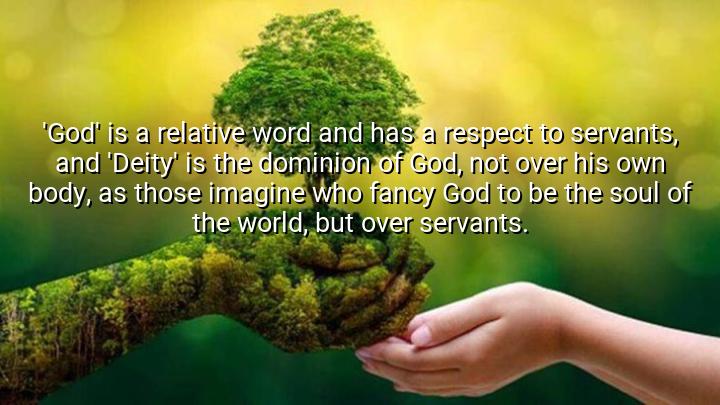




The quote by Isaac Newton explores the distinction between the terms “God” and “Deity” in the context of theology and philosophy. Newton explains that “God” is a relative word, meaning it describes a relationship—specifically God’s relationship to His servants. On the other hand, “Deity” refers to the dominion or authority of God, not as an abstract force within the universe, but as a sovereign ruler over creation. This clarification reflects Newton’s belief in a personal God rather than a pantheistic view that equates God with the soul of the world.
The meaning of the quote lies in Newton’s effort to distinguish between titles and essence. For him, to call God “God” was to acknowledge His relationship of authority to humanity and the world, while “Deity” pointed to His supreme power. Newton criticizes those who imagine God as merely a world soul, emphasizing instead a vision of God as an active, ruling being who governs over His servants. This shows how Newton combined his scientific genius with a deep engagement in theological reflection.
The origin of this thought comes from Newton’s religious and philosophical writings, particularly found in his less-publicized manuscripts on theology and natural philosophy. Although Newton is best remembered for his contributions to mathematics and physics, he devoted much of his life to studying scripture, church history, and metaphysics. His reflections often addressed the nature of God, the distinction between true worship and superstition, and the relationship between divine sovereignty and human understanding.
Ultimately, Newton’s quote reflects his conviction that God should not be reduced to abstract speculation but understood in terms of His dominion, authority, and relationship to creation. It highlights his commitment to reconciling reason, science, and faith, making clear that for him, God was not simply a philosophical idea but a living ruler worthy of reverence and respect.

AAdministratorAdministrator
Welcome, honored guests. Please leave a comment, we will respond soon