

Vision is the art of seeing what is invisible to others.
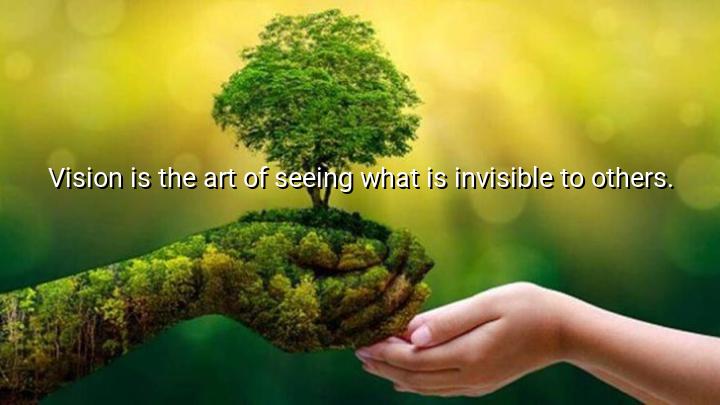




Jonathan Swift’s quote, "Vision is the art of seeing what is invisible to others," speaks to the unique power of imagination and insight. Swift suggests that true vision involves perceiving things that are not immediately apparent or visible to the average person. It refers to the ability to see beyond the surface of things and recognize deeper meanings, possibilities, or potential that others may overlook or fail to understand.
By describing vision as an art, Swift emphasizes that this skill is not merely a passive observation, but an active and creative process. It’s about interpreting the world in a way that goes beyond conventional thinking, using one’s intuition, creativity, and insight to uncover truths or possibilities that may not be immediately clear. This can apply to artists, innovators, or even leaders who have the ability to envision a future that others cannot yet see.
Swift’s quote also highlights the difference between perception and reality. While many people see only what is directly in front of them, someone with true vision has the ability to imagine what could be, whether that’s in the realm of art, science, or personal growth. It suggests that those who can see the invisible often shape the future by acting on their innovative ideas.
Ultimately, the quote encourages creative thinking and the pursuit of ideas that push the boundaries of what others may consider possible. Swift’s words remind us that true vision requires not just seeing what is in front of us, but recognizing potential, change, and innovation in what remains unseen by most.

THNguyen thu hang
Swift's quote is so powerful in its simplicity. Vision is not just about seeing things clearly; it's about perceiving the unseen. But I can't help but wonder—how do we ensure that what we perceive as 'invisible' isn’t just a projection of our own biases or desires? In what ways do our life experiences shape what we consider ‘invisible’? Can vision be truly objective, or is it always shaped by personal context?
HPLe Huu Phuoc
Jonathan Swift’s words really speak to the idea of thinking outside the box. The notion that vision is the ability to see what’s invisible to others suggests that innovation stems from unique perspectives. But what happens when those who see the invisible are not believed or accepted? How do people with visionary ideas push forward when the rest of the world is too focused on the visible, concrete reality? Is perseverance enough, or do they need something else to make their vision a reality?
TTeddy
I love the idea that vision allows you to see what others can’t. It’s a reminder that true leaders or innovators often see potential where others see limitations. But it also makes me curious about how society defines 'invisibility.' If only a few people can see what's 'invisible,' is that vision truly universal or just subjective? And can a visionary perspective be understood or appreciated by the masses, or does it always remain out of reach for most?
DNdai ngo
This quote feels empowering, like a call to develop our ability to perceive beyond the surface. But what about the dangers of seeing things that aren't there? Can a strong vision sometimes lead people down the wrong path or cause them to misunderstand reality? How do we balance vision with a healthy dose of skepticism? At what point does 'seeing the invisible' become more of a delusion than a gift?
NTha thi ngoc thao
Swift's quote really stands out to me. Vision is often associated with seeing the future or having a clear goal, but this quote expands it into something deeper. It makes me think: are the things that are invisible to others truly valuable? Or are we just projecting our own desires onto them? What role does intuition play in developing this 'vision,' and how do we ensure it’s not clouded by bias or wishful thinking?