

Dear God! how beauty varies in nature and art. In a woman the flesh must be like marble; in a statue the marble must be like flesh.
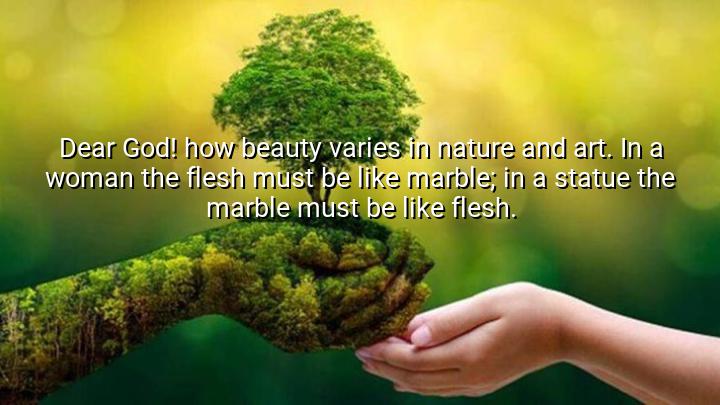




Victor Hugo’s quote, “Dear God! how beauty varies in nature and art. In a woman the flesh must be like marble; in a statue the marble must be like flesh,” expresses his fascination with the contrasting ideals of beauty in nature versus art. Hugo, a towering figure in French literature, is known for his poetic and philosophical reflections on human nature, aesthetics, and society. In this line, he marvels at how art and reality reflect and reverse each other’s qualities in the pursuit of perfection.
The quote highlights a paradox: in nature, specifically in the human form, beauty is associated with qualities like smoothness, firmness, and idealized symmetry—as if the flesh were sculpted from marble. Conversely, in sculpture, which is made from cold, hard stone, the artist’s goal is to give the marble a sense of warmth, life, and sensuality, making it seem as though it were living flesh. Hugo is pointing out the artistic illusion that turns inanimate material into something that emotionally and visually imitates life.
This quote also speaks to the transcendent power of art—its ability to mimic, idealize, and even transform nature. While nature creates life, art seeks to evoke the same emotional response through craftsmanship and technique. The balance between the two lies in their ability to reflect each other: art strives to feel alive, and life, when idealized, is imagined as something sculptural or eternal.
Ultimately, Hugo’s observation is a meditation on the duality of beauty. It invites the reader to consider how aesthetic ideals shift depending on the medium and the context, and how the human desire to capture perfection leads us to blur the lines between what is natural and what is created. Through this poetic contrast, he celebrates both artistic mastery and the mysterious elegance of living form.

SCson chau
As a reader, I’m struck by how much weight this places on aesthetic perfection—both in living people and in art. Is Hugo suggesting that beauty is only meaningful when it crosses the boundary between illusion and reality? I’m also thinking about how modern art breaks away from such ideals. Would this sentiment still resonate today, or would it be criticized for promoting outdated standards of beauty, especially toward women?
TLTue Le
This quote is stunningly visual, but also raises questions about idealism versus realism in both art and human perception. The notion that art must soften stone into lifelike beauty, while real life must attain the cool perfection of marble, is paradoxical. Do we ever really appreciate things as they are, or only as we imagine them to be in contrast to their opposite? Hugo seems to be wrestling with expectations more than essence.
VTHanh Vo Thi
Victor Hugo’s quote makes me wonder whether he saw art as superior to nature or simply different. There’s a sense of awe in how he compares the two, but I’m curious—does this idea elevate art by forcing it to mimic life, or diminish it by suggesting it can never quite achieve nature's spontaneity? Also, how do modern ideas of beauty challenge this very fixed, almost sculptural notion of the ideal female form?
TNPhuong Thanh Nguyen
I find this quote fascinating—it draws a beautiful parallel between life and art, but I’m left pondering the deeper meaning. Is Hugo commenting on the transformative power of art? How it must imitate life so closely that it takes on its essence? And yet, he sets a very specific standard for women’s beauty. Why do you think he uses marble as an ideal for flesh? It seems both reverent and limiting.
TTtruong traidat
This quote is so evocative, but also a little troubling. It makes me wonder—why is the ideal of beauty in a woman compared to marble, something cold and hard? Is Hugo admiring timelessness, or is there an underlying objectification here? I love the poetic reversal between flesh and stone, but I can't help questioning the gender implications. Is this just a reflection of his time, or something deeper we still carry today?