

The essence of all beautiful art, all great art, is gratitude.
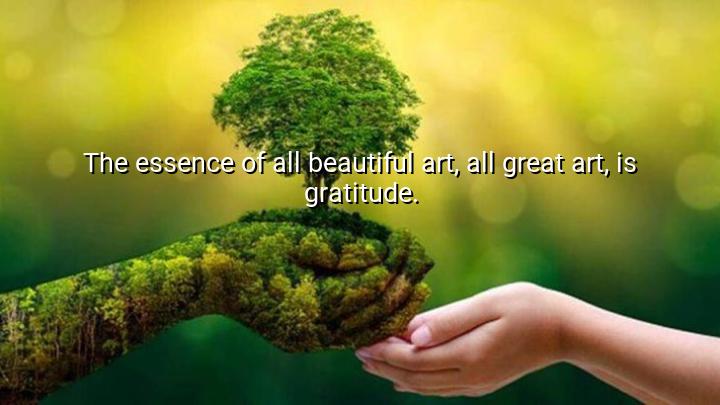




The quote "The essence of all beautiful art, all great art, is gratitude" by Friedrich Nietzsche reflects the profound connection between art and the human experience of appreciation. Nietzsche suggests that true art arises from a deep sense of thankfulness, whether it be for life, nature, or the creative process itself. The artist’s ability to channel their gratitude into a work of art transforms it into something beautiful and meaningful.
Nietzsche's perspective on art challenges the conventional view that great art is purely about expression or technique. Instead, he argues that it is the gratitude within the artist that gives the work its depth and significance. This notion is deeply tied to Nietzsche's broader philosophy, where he often emphasized the importance of embracing life’s challenges and finding meaning in suffering and existence.
The quote also reflects Nietzsche's admiration for artists who create not out of mere necessity but out of a recognition of the beauty in life and the human condition. For Nietzsche, gratitude serves as a powerful motivator that propels artists to express their innermost emotions, which resonate universally with others.
In this sense, the quote underscores the transformative power of gratitude in shaping not just art but the way we experience the world. Nietzsche’s words encourage us to look beyond the surface of art and recognize the deeper, often unspoken emotions and gratitude that fuel the creative process.

VNVi Nguyen
This quote really shifts how I think about the relationship between the artist and their work. Is Nietzsche suggesting that all great art, even art born from struggle or pain, carries an underlying sense of gratitude? Or is gratitude about recognizing the beauty in both the good and bad parts of life? Does that mean the process of creating is as much about appreciating life’s complexities as it is about expressing emotions?
LLLi Li
I like the idea that art is rooted in gratitude, but I wonder if it’s a bit idealistic. Can you always trace gratitude as the essence of great art? What about art that’s born from conflict, rebellion, or destruction? It could be argued that such art is still great because it challenges, inspires, or changes perspectives, even if it’s not explicitly about gratitude.
BHlee baor haong
Nietzsche’s quote makes me reflect on how art can emerge from many different emotional states, yet it’s interesting to think about gratitude being at the core of all great art. Does this mean that even in pain or hardship, the artist is grateful for the opportunity to create or express something meaningful? Or is the gratitude simply an acknowledgment of what has been experienced or learned from the act of creation?
TNThien Nguyen
This is such an interesting take on art. I’ve always thought of great art as an expression of the artist’s emotions, thoughts, or experiences, but Nietzsche introduces a deeper layer with gratitude. Does art need to express gratitude to be considered truly beautiful or great? Can art that comes from pain, anger, or disillusionment still be great if it’s not rooted in a sense of thankfulness?
KPKiet Phan
I find Nietzsche’s perspective fascinating, but I’m curious—does this mean that all art should be seen as a thank-you to the world, or is gratitude something that only certain pieces of art express? Can art that’s critical or dark, like some political or abstract art, still be great, or does it have to express gratitude in some form to fit Nietzsche’s definition of beauty and greatness?