

One eye sees, the other feels.
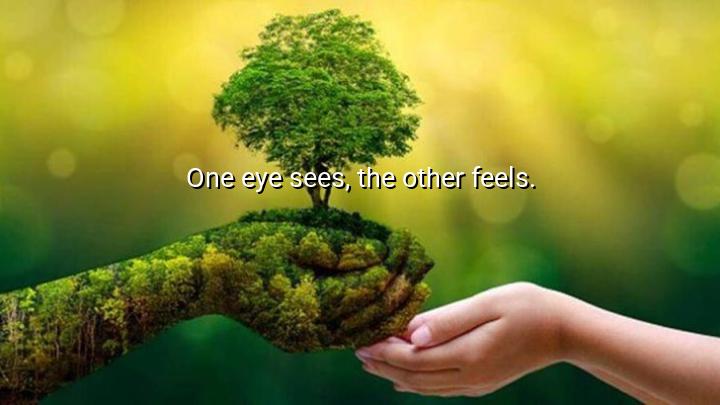




The quote "One eye sees, the other feels" by Paul Klee reflects the idea that perception goes beyond what is visible to the eye. Klee, a Swiss-German artist known for his unique blend of abstract and expressionist styles, suggests that true understanding and connection with the world come from both the visual and emotional senses. The eye that "sees" represents the physical act of looking, while the eye that "feels" symbolizes a deeper, more intuitive connection to what is being observed.
For Klee, the act of creating or experiencing art is not limited to intellectual or sensory observation alone. It involves a combination of the rational and the emotional, where the viewer or artist must connect with the essence of what they see. The feeling eye speaks to the artist’s ability to express not just the visual, but also the emotional and spiritual dimensions of the subject matter.
This concept also ties into Klee’s broader philosophy of art, which emphasized the subjective and emotional aspects of the creative process. His works often blurred the lines between what is seen and what is felt, creating a fusion of visual and emotional experience. The quote underscores the notion that true art is more than what meets the eye—it resonates with the heart and soul of the observer or creator.
Klee’s quote invites us to think about art and perception in a holistic way. It suggests that to truly appreciate art, we must engage both our rational sight and our emotional intuition, allowing us to understand and feel the deeper meanings behind the visuals.

HTloan hoang thi
This quote feels like it acknowledges that perception is more than just objective sight; it’s also about what we feel. Do you think the two senses are equally important in art and creativity? Can we truly appreciate art if we only use one eye to observe it, or does it lose its depth? Is Klee suggesting that the real essence of art or life comes when we let the mind and emotions collaborate?
MTPHUNG MINH THU
Klee’s quote speaks to how subjective our experience of the world really is. It makes me wonder: if one eye sees and the other feels, how much of what we experience visually is colored by our emotions? Could our feelings actually shape how we interpret visual stimuli in a way that’s beyond conscious control? What role do intuition and instinct play in our creative expressions?
NDNhan Duc
It's fascinating that Klee pairs sight with feeling. In a way, it suggests a deeper level of perception that goes beyond what’s visible. Do you think that our feelings shape how we see the world, and vice versa? How might this concept apply to creativity? Is the most powerful art the kind that engages both our mind and our emotions at once, creating a more immersive experience?
APNgoc Anh Pham
I love how this quote taps into the sense of seeing beyond the literal. Is Klee implying that true understanding comes from both intellectual observation and emotional connection? In terms of art, does this suggest that the best pieces evoke both a mental and emotional response, creating a more holistic experience? Or do you think it's more about the artist's ability to make others feel through what they see?
MTnguyen mai trang
This idea of having one eye that 'sees' and the other that 'feels' feels almost like a metaphor for the way we experience life itself. Can we ever fully separate what we observe from how we feel about it? Does Klee mean that the most profound experiences or artworks happen when we allow our emotions and senses to work together, rather than relying on just one perspective?