

The art of storytelling is reaching its end because the epic side of truth, wisdom, is dying out.
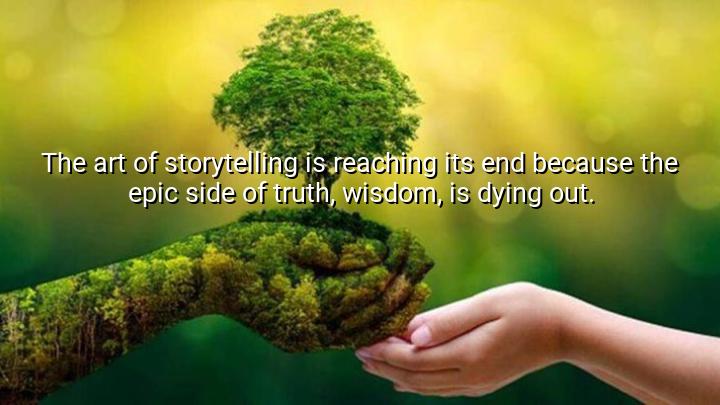




The quote "The art of storytelling is reaching its end because the epic side of truth, wisdom, is dying out" by Walter Benjamin speaks to the diminishing role of traditional storytelling in contemporary society. Benjamin, a German philosopher and cultural critic, suggests that storytelling, particularly the epic or grand narrative style of storytelling, is losing its significance as a means of conveying deep truth and wisdom. In earlier times, stories were an essential part of how knowledge, cultural values, and moral lessons were passed down through generations.
In this context, the "epic side of truth" refers to the profound, often larger-than-life tales that conveyed wisdom, moral guidance, and a sense of collective experience. These stories, often rich in allegory and meaning, were not just entertainment but a way for people to connect with deeper truths about life and human nature. However, Benjamin suggests that this form of storytelling is dying out in the modern world, replaced by more fragmented, superficial forms of communication that lack the depth and narrative structure of the past.
The decline of storytelling in the epic sense is tied to the rise of modernity, where the immediacy of technology and mass media often overshadows the slow, reflective process of oral or written storytelling. As people increasingly turn to technology for information and entertainment, the opportunity for storytelling to impart wisdom in a meaningful, lasting way is diminished. The storytelling tradition that once brought communities together and imparted important life lessons now struggles to find its place in a fast-paced, media-driven world.
In essence, Benjamin's quote reflects a lament for the loss of a form of art that was deeply connected to the transmission of collective wisdom and truth. He sees the decline of the epic storytelling tradition as a loss for society, as it represents a shift away from more meaningful, introspective ways of understanding the world toward more fleeting, superficial forms of communication. For Benjamin, the art of storytelling was not only a method of entertainment but a crucial way of preserving wisdom and connecting to the deeper truths of human existence.

TVLuu Ngoc Tuong Vy
This quote almost feels like a challenge. If the art of storytelling is fading, what can we do to keep it alive? Are we, as readers and creators, responsible for preserving wisdom-laden narratives? It also makes me reflect on the role of education—are we teaching young people to value the depth in stories, or just how to analyze plot points for tests? Maybe the problem isn’t the medium but our collective attention span.
AKAnh Kieu
I’m intrigued by the phrase 'epic side of truth.' What exactly is dying out here—epicness, truth, or wisdom? Are these elements inseparable in storytelling? I wonder whether Benjamin is lamenting the loss of oral traditions where wisdom was passed down with emotional richness and cultural weight. Does the commodification of stories strip them of the very soul he’s referring to? Can storytelling still be sacred in a consumer-driven society?
LMLe Minh
This quote stirs a kind of existential sadness in me. Has our obsession with instant gratification really eroded our ability to absorb stories that carry deeper truths? I think about how ancient epics like the Mahabharata or The Odyssey weren’t just entertainment—they were moral compasses. Is our storytelling now too centered on spectacle rather than substance? What would Benjamin say about today’s world of AI-generated content and viral trends?
DQTran Diem Quynh
Benjamin’s reflection feels prophetic, especially considering our current media landscape. But I question whether storytelling is truly ending, or if it’s just being reshaped. Are video games, streaming series, and even podcasts not modern epics in disguise? Maybe it’s not the form that’s fading, but the reverence for wisdom in those stories. Could it be that we need to seek or demand more depth from our narratives, rather than mourning their decline?
THTrong Hai
I find this quote from Walter Benjamin deeply melancholic. It makes me wonder—has the digital age truly diluted the 'epic side' of storytelling? Today we consume stories in fragments—tweets, reels, headlines. Are we losing the kind of narrative that spans generations and carries deep wisdom? Or is it just evolving into something different? I'd love to hear thoughts on whether long-form storytelling still has a place in modern culture.