

The only way of knowing a person is to love them without hope.
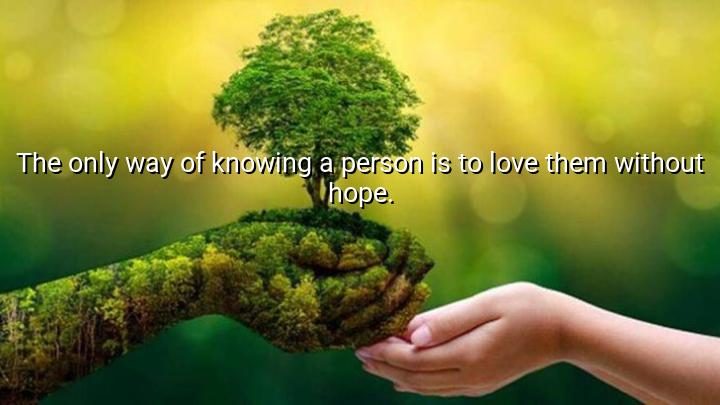




Walter Benjamin’s quote, "The only way of knowing a person is to love them without hope," suggests that true understanding of another person comes not from expectations or desires, but from unconditional love. By loving someone without the attachment to any particular outcome or reward—without hope for something in return—one can truly understand their essence. This idea challenges the transactional nature of many relationships, urging a shift towards selfless and authentic connection.
The concept of loving "without hope" also ties into the notion of acceptance and vulnerability. When we love someone without any conditions, we accept them fully, including their flaws, and we see them for who they truly are, not for what we might gain from them. In this way, Benjamin suggests that genuine intimacy and connection arise from a love that is not tied to selfish expectations but is given freely, allowing for a deeper understanding of the other person.
Benjamin’s words also touch on the philosophical themes of selflessness and pure affection. To love without hope is to step away from the ego, where love is often motivated by personal gain, and instead enter a realm where love exists solely for the sake of the other. This form of love is not about attachment or possession, but rather about empathy and unconditional regard for another’s well-being and humanity.
The origin of this quote is tied to Walter Benjamin’s work as a German philosopher and cultural critic. Known for his thoughts on aesthetics, literature, and history, Benjamin often explored the complexities of human relationships, suffering, and redemption. This quote encapsulates his belief that true understanding and connection with others come from a place of selfless love, beyond the realm of expectations or the pursuit of personal gain.

AAdministratorAdministrator
Welcome, honored guests. Please leave a comment, we will respond soon