

Boredom is the dream bird that hatches the egg of experience. A rustling in the leaves drives him away.
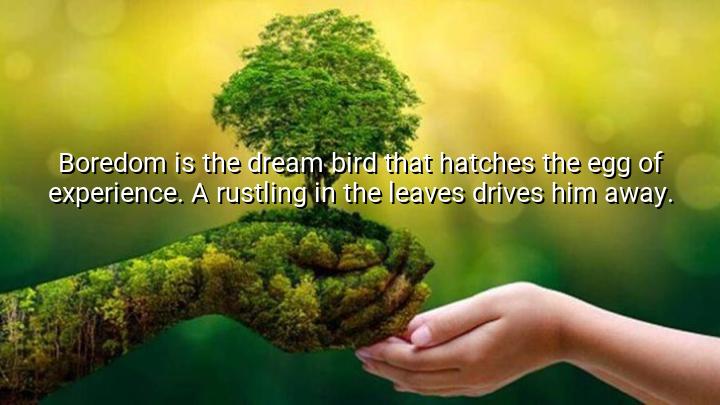




Walter Benjamin’s quote, "Boredom is the dream bird that hatches the egg of experience. A rustling in the leaves drives him away," uses metaphor to explore the relationship between boredom and personal growth. Benjamin suggests that boredom, often viewed negatively, serves as the incubator for new experiences. When we are bored, our minds are free to wander and reflect, which can lead to insights, creativity, and new understandings—symbolized here as the egg of experience. Boredom, therefore, has the potential to nurture and foster development, even though it may not be immediately enjoyable.
The second part of the quote, "A rustling in the leaves drives him away," introduces the idea that distractions or external stimuli can interrupt this process of growth. The rustling represents the external forces that pull us away from introspection, keeping us from fully engaging with the opportunity for growth that boredom offers. It implies that in a world filled with constant noise and stimulation, we are often denied the space needed for the hatching of meaningful experiences.
Benjamin’s reflection emphasizes the idea that true experience comes from moments of stillness or solitude, where boredom has the space to foster deeper thoughts and reflections. Yet, the quote also acknowledges that we are frequently distracted, preventing us from engaging fully with this process. It’s a commentary on how modern life often interferes with our ability to find meaning in seemingly dull moments.
The origin of this quote lies in Benjamin’s philosophical explorations of time, culture, and experience. Known for his insights into the nature of modernity and the human condition, Benjamin often critiqued the fast-paced, consumer-driven world that limits genuine reflection. This quote reflects his belief that boredom can be a catalyst for deeper engagement with life, but only if we allow ourselves to be fully present in the moment and resist the urge for constant distraction.

AAdministratorAdministrator
Welcome, honored guests. Please leave a comment, we will respond soon