

If we want to make sense of our behavior - all the best, worst, and everything in between - we're not going to get anywhere if we think it can all be explained with one thing, whether it's one part of the brain, one childhood experience, one hormone, one gene, or anything.
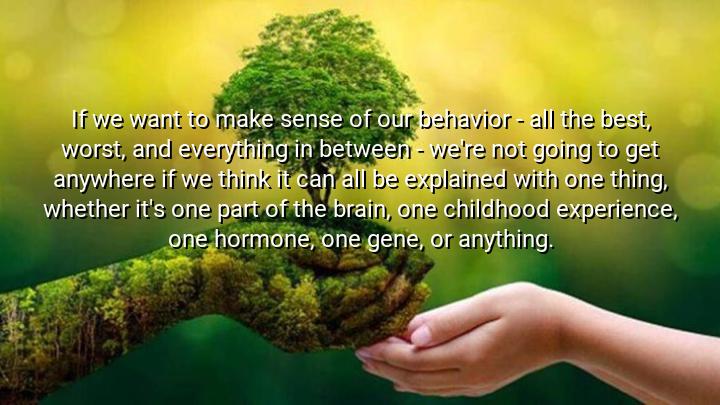




Robert Sapolsky’s quote, “If we want to make sense of our behavior—all the best, worst, and everything in between—we're not going to get anywhere if we think it can all be explained with one thing, whether it's one part of the brain, one childhood experience, one hormone, one gene, or anything,” speaks to the complexity of human behavior. Sapolsky, a renowned neuroscientist and biologist, argues that our actions, decisions, and emotional responses cannot be fully understood through a single cause or factor. Instead, human behavior is the product of a vast, interconnected web of biological, psychological, and social influences.
The quote challenges the reductionist approach, which attempts to explain complex phenomena by focusing solely on one element—such as a single hormone, a particular genetic trait, or a single traumatic event. While each of these factors can play a role in shaping who we are, Sapolsky highlights that understanding human behavior requires a more holistic perspective. Rather than simplifying our actions down to one cause, it’s crucial to recognize the multifaceted nature of human nature, where many factors interact and contribute to how we behave.
Sapolsky’s perspective also emphasizes the interconnectedness of different domains—biological, environmental, and personal experiences. For example, while brain activity certainly influences behavior, it is not solely responsible for everything we do. Childhood experiences, cultural influences, personal relationships, and even broader societal factors all shape our behavior in ways that cannot be captured by focusing on just one piece of the puzzle. The quote reflects a deep respect for the complexity of human nature, encouraging a more nuanced approach to understanding ourselves and others.
Ultimately, Sapolsky is advocating for a more integrated approach to studying human behavior—one that acknowledges the diversity of influences at play. His words remind us that when we try to explain behavior, we must consider the full range of possible causes, rather than oversimplifying it to a single element. This view encourages us to embrace the complexity of human experience and the multitude of factors that influence who we are and how we act.

AAdministratorAdministrator
Welcome, honored guests. Please leave a comment, we will respond soon