

Every happening, great and small, is a parable whereby God speaks to us, and the art of life is to get the message.
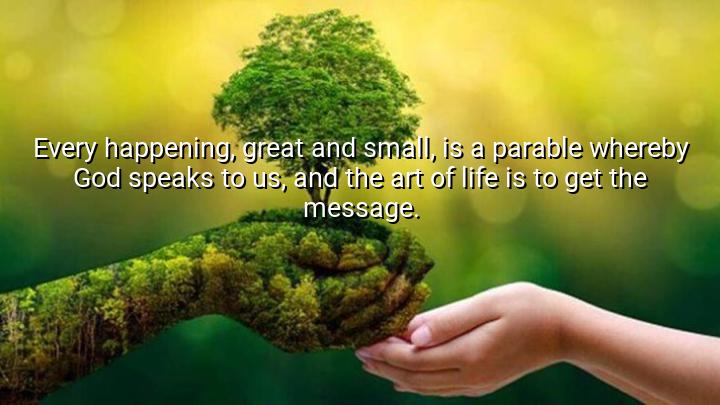




The quote "Every happening, great and small, is a parable whereby God speaks to us, and the art of life is to get the message" by Malcolm Muggeridge reflects the belief that every event in life, whether significant or trivial, carries a deeper meaning or lesson intended by a higher power. Muggeridge, a British journalist and author with a strong Christian faith, suggests that life itself is filled with signs and messages that require us to pay attention and interpret the parables that unfold around us. He views life as a form of communication between God and humanity, where we must be alert to the lessons embedded in our everyday experiences.
By describing events as parables, Muggeridge emphasizes that even the simplest occurrences are laden with meaning and that these events are often symbolic, offering insights into spiritual and moral truths. A parable is typically a story used to convey a deeper message, often with moral or religious undertones, and Muggeridge is suggesting that life operates in a similar way—every moment holds potential wisdom for those who are willing to reflect upon it.
The art of life, according to Muggeridge, is about recognizing these messages. It is not enough to simply go through life without awareness; the true challenge is to understand the lessons and deeper meanings hidden within our experiences. This requires self-reflection, patience, and the ability to see beyond the surface of daily life, seeking out the purpose and guidance in everything that happens.
In essence, Muggeridge’s quote encourages a spiritual and thoughtful approach to life, where every happening—whether joyful or painful—becomes an opportunity for growth and deeper understanding. The art of life, then, is the capacity to interpret these experiences as messages from God, leading us toward greater wisdom and connection with the divine.

ATPham Anh Thu
This quote raises a deep question about interpretation: how do we discern what the message is? If everything is a parable, then what role does individual bias play in interpreting it? Can two people experience the same event and walk away with opposing but equally valid 'messages'? That ambiguity is both inspiring and unsettling—because it puts a lot of responsibility on us as interpreters of our own lives.
ALHoang Anh Luong
Muggeridge’s idea brings a kind of sacredness to daily life, and I find that beautiful. It makes me reflect on how often I overlook the 'small happenings'—a conversation, a moment of stillness, a mistake. If we treated every moment as potentially meaningful, would it change how we live? Maybe the challenge is slowing down enough to notice what life is trying to say before we rush on.
NALam Ngoc Anh
I love how this quote frames life as a series of parables—it’s poetic and thought-provoking. But I wonder: does this view apply universally, or is it more accessible to those who already have a spiritual or religious mindset? If someone doesn’t believe in a divine presence, can they still find meaningful lessons in everyday events, or is that experience inherently tied to belief in God?
HDHuong Dz
Do you think this perspective encourages people to over-interpret events in their lives? While it's a comforting thought that everything has meaning, could it also lead to people forcing symbolic value onto situations where there is none? I'm curious about how this way of thinking balances with logic and randomness, especially in a world increasingly shaped by chance and chaos.
BBookin
This quote really struck a chord with me. It suggests that everything, from the mundane to the monumental, carries meaning. But how do we know when we've understood the message correctly? Sometimes, life feels so random or cruel—how are we supposed to find purpose or divine communication in suffering or failure? I wonder if the ‘art’ Muggeridge refers to is less about certainty and more about developing the patience to listen deeply.