

One of the many pleasures of old age is giving things up.
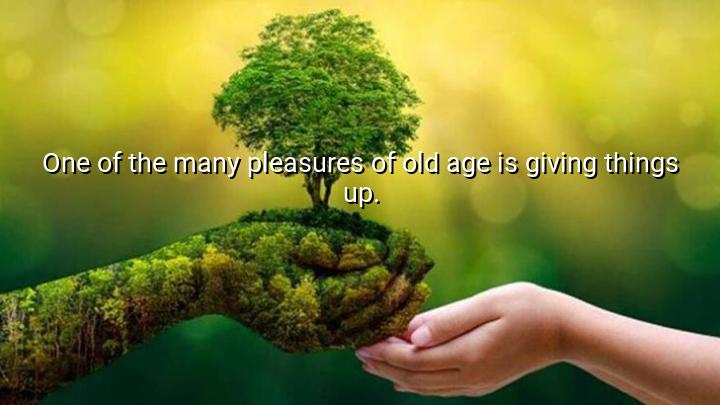




The quote "One of the many pleasures of old age is giving things up" by Malcolm Muggeridge highlights an often overlooked aspect of aging—the freedom and relief that can come from letting go of responsibilities, desires, and material possessions. Muggeridge, a British journalist, satirist, and social commentator, often explored themes of aging, simplicity, and contentment. In this quote, he suggests that as we grow older, there is a certain joy in shedding the complexities and burdens that once defined our lives.
Muggeridge’s observation implies that, with age, people often experience a shift in perspective, where they no longer feel the need to constantly acquire, compete, or maintain what society deems important. Instead, giving things up—whether they are material possessions, ambitions, or even societal expectations—becomes a form of freedom and peace. This relinquishing of things allows individuals to focus on what truly matters, such as relationships, personal growth, and inner contentment.
The quote also touches on the idea of detachment, a common theme in many philosophical and spiritual traditions. As people age, they may come to realize that many of the things they once valued no longer hold the same significance. Muggeridge, with his characteristic wit, suggests that the act of letting go can be liberating, as it frees individuals from the constraints and pressures of materialism and societal norms.
Ultimately, Muggeridge’s quote emphasizes that old age can bring not just physical limitations but also a kind of wisdom and peace that comes from releasing the clutter of life. It suggests that there is joy in simplicity, and that aging offers the opportunity to embrace a more focused and satisfying existence, unburdened by unnecessary desires.

HHiAmAatrox
Reading this quote, I can't help but feel conflicted. On one hand, it seems like a graceful acceptance of life’s natural rhythms. On the other, it could be interpreted as resignation. Is the 'pleasure' in giving up really freedom, or is it masked regret? Maybe the key lies in how we frame it—choosing to release what weighs us down versus feeling like we’re forced to let go of what we love.
MApham my anh
This quote has a quiet elegance to it. I’m intrigued by the idea that surrender can be joyful instead of sorrowful. Does it mean we finally get to stop chasing youth, status, or perfection? If so, there’s real power in that. But does everyone experience aging this way? Or is this perspective a luxury for those who have already achieved a sense of fulfillment or stability?
PNPhuc Nguyen
Isn't it interesting how this quote invites us to rethink aging as a simplification of life rather than a decline? I wonder what Muggeridge had in mind—was he talking about physical things, expectations, or even relationships? It raises the question: does aging offer a form of minimalism that helps us focus on what really matters? Maybe that’s the true pleasure—finally knowing what we no longer need.
TPNguyen Truong Phuc
I found this quote thought-provoking. At first, it sounds a little bleak, but the more I sit with it, the more I see the wisdom. There’s a peacefulness in realizing that not everything needs to be held onto forever. But I wonder, is this pleasure truly universal? Or does it depend on what you’re giving up—bad habits, perhaps, versus passions or dreams? That distinction seems pretty important.
MLtong minhnh li
This quote is unexpectedly refreshing. It flips the narrative of aging being about loss into something almost liberating. Could it be that old age allows us to finally let go of unnecessary responsibilities, ego, or societal pressures? Maybe there’s joy in shedding layers that no longer serve us. I’m curious—how do we distinguish between what’s a true gain and what’s just giving up because we’re told we must?