

Arguments only confirm people in their own opinions.
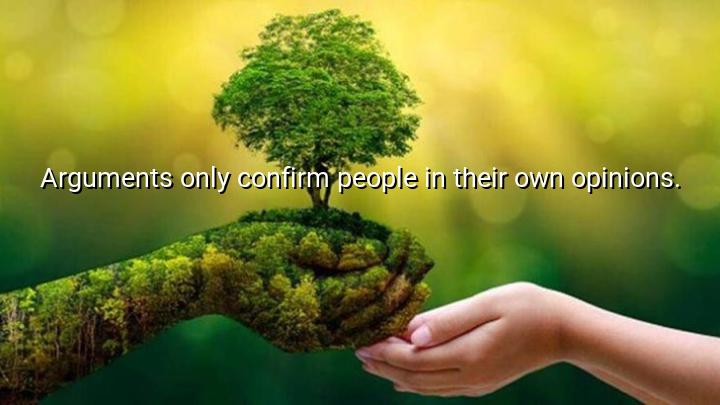




In this quote, Booth Tarkington suggests that arguments often have little effect on changing people’s minds; instead, they tend to reinforce the opinions that individuals already hold. Tarkington implies that rather than fostering understanding or encouraging critical thought, arguments often lead to entrenchment in one's existing beliefs. This reflects the idea that people tend to view disagreements through the lens of their own biases, making it difficult for rational discussion to change their perspective.
Tarkington’s statement also touches on the psychological aspect of human nature, where people are often more focused on defending their views than genuinely listening to opposing ideas. Arguments can become battlegrounds for pride and self-validation, where the goal is not to find truth, but to assert dominance or prove one's point. In such situations, each side leaves the argument feeling more confirmed in their position rather than gaining any new insights.
The origin of this quote lies in Tarkington’s keen observations of human behavior and social dynamics. As an author and playwright, he often explored themes of human folly and social interaction, and this quote reflects his understanding of how people interact when they are deeply attached to their own views. Rather than encouraging open-mindedness, arguments often just create deeper divides between individuals or groups.
Ultimately, Tarkington’s quote serves as a reminder of the limitations of argumentation in changing people’s minds. It encourages us to consider alternative methods of communication and understanding, such as empathy, open dialogue, and mutual respect, which may be more effective in fostering genuine change in perspectives.

NANguyen Ngoc Anh
This quote makes me question the value of argumentation itself. If it only confirms opinions, should we focus more on dialogue, questions, and curiosity? How do we encourage people to be open-minded and willing to reconsider their beliefs? It would be interesting to explore cultural differences in how people handle disagreements and whether some traditions foster more openness than others.
HAPham Hoang An
I wonder if this phenomenon relates to the psychological concept of cognitive dissonance—when confronted with opposing views, people double down to protect their self-concept. How can we overcome this natural resistance to change? Are there communication techniques that can bypass this defensive reaction? I’d love to hear examples where arguments have successfully led to changed opinions instead of hardened stances.
XGPhuong Anh Xinh Gai
The quote suggests a kind of emotional attachment to beliefs that makes arguments reinforcing rather than enlightening. Does this mean people argue more to defend identity than to seek truth? How do we recognize when an argument is productive versus when it’s just confirming bias? It raises questions about how education and critical thinking skills can help people engage differently.
Nnguyen2009
This idea makes me reflect on how social media platforms amplify echo chambers. Do arguments online just push people further into their views because they lack nuance and empathy? How can we create spaces for open conversation that encourage flexibility rather than defensiveness? I’d like to explore strategies for productive disagreement that actually lead to growth and change.
BDNguyen Ba Duong
I find this statement a bit pessimistic but realistic. If arguments just reinforce existing opinions, how can meaningful dialogue happen? Could this imply that persuasion requires a different approach—like storytelling or shared experiences rather than confrontation? I wonder if this also depends on the context and the relationship between people arguing. Is it easier to change opinions in some settings than others?