

When a man points a finger at someone else, he should remember that four of his fingers are pointing at himself.
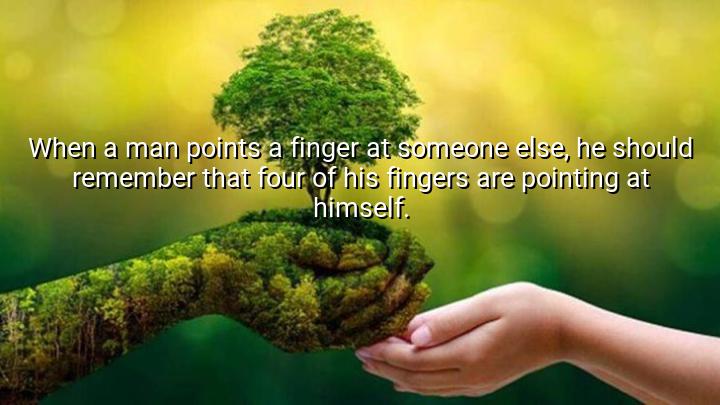




In this quote, Louis Nizer uses a metaphor to illustrate the idea of self-reflection and the importance of accountability. He suggests that when a person points a finger at someone else, accusing them of wrongdoing or fault, they should remember that they are not without fault themselves. The metaphor of four fingers pointing back at himself emphasizes that we often overlook our own flaws and responsibilities while focusing on the perceived faults of others.
Nizer’s words serve as a reminder of human imperfection and the tendency to criticize others without acknowledging our own shortcomings. The quote calls for self-awareness and humility, urging individuals to examine their own behavior and actions before passing judgment on others. It stresses the idea that no one is free from errors or mistakes, and that we should approach others with understanding rather than criticism.
The underlying message of the quote is one of compassion and personal growth. By recognizing that we are all susceptible to the same flaws, we are more likely to show empathy and a willingness to correct our own behavior. Instead of focusing on the wrongdoings of others, we can redirect our attention to improving ourselves.
Ultimately, Nizer’s quote challenges us to be more introspective and to take responsibility for our own actions. It encourages us to resist the urge to judge others harshly, especially when we are just as prone to mistakes. By fostering a sense of accountability and self-reflection, we can build stronger, more compassionate relationships with others.

TThoangf tuans tu
I find this quote quite powerful as a tool for self-reflection, but I wonder how it plays out psychologically. Do people naturally resist acknowledging the ‘four fingers’ pointed at themselves? What cognitive biases might prevent someone from seeing their own faults when blaming others? This could be a good starting point for discussions about emotional intelligence and how we cultivate honesty with ourselves.
NTNguyen Thinh
The quote feels like a warning against quick judgment but also a lesson in empathy. If four fingers point back at us, maybe we should pause and consider our shared human flaws before condemning others. Does this encourage forgiveness and understanding? Or could it sometimes be used as an excuse to avoid responsibility altogether? I'm interested in how this metaphor impacts personal growth and conflict resolution.
HHTran Thi Hong Hanh
Reading this, I think about how it could apply to social and political discourse. Are leaders or influencers who blame groups or individuals ignoring their own contributions to problems? How might this metaphor help foster more constructive dialogue in polarized environments? It suggests a need for collective responsibility, but how do we encourage people to look inward honestly in such public contexts?
GDGold D.dragon
Sometimes I feel this quote highlights the hypocrisy we see in everyday interactions—people quick to accuse but slow to reflect. But is this always fair? Could there be situations where pointing a finger is justified and necessary without self-blame? How do we balance holding others accountable while still acknowledging our own imperfections? This makes me question if self-criticism should always accompany criticism of others.
LMChau 20_7025 Le Minh
I appreciate the clever imagery here, but it also raises a question about responsibility. Could this idea suggest that blame is never completely external? Does this mean that any conflict involves at least some fault on both sides? I'm curious how this perspective might change how we approach conflicts in relationships or at work. Would focusing on our own faults first help resolve disputes more effectively?