

We are already perilously close to killing off the top of the oceanic food chain - with catastrophic consequences that we can't begin to imagine. Let us not, in the heat of anger, reduce the already devastated population of great white sharks by one more member.
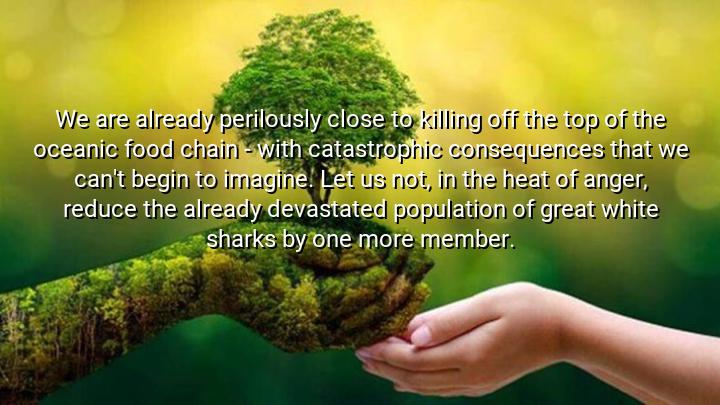




Peter Benchley's quote, "We are already perilously close to killing off the top of the oceanic food chain - with catastrophic consequences that we can't begin to imagine. Let us not, in the heat of anger, reduce the already devastated population of great white sharks by one more member," speaks to the critical importance of protecting the oceanic food chain and the species that inhabit it, particularly great white sharks. Benchley is warning that the unchecked destruction of these apex predators could lead to disastrous ecological imbalances, affecting the entire marine ecosystem in ways we may not fully understand yet.
The origin of this quote lies in Benchley’s deep concern for environmental conservation and the protection of marine life, specifically sharks. The destruction of the oceanic food chain, primarily through overfishing, habitat destruction, and human-induced threats, threatens not only sharks but also the stability of marine ecosystems as a whole. Benchley emphasizes the catastrophic consequences that could arise from further reducing the populations of great white sharks, creatures that play a vital role in maintaining the health of the ocean.
Benchley further urges restraint in the face of anger, recognizing that the emotional response to sharks—often driven by fear or misinformation—can lead to actions that harm rather than help. He calls for a more measured approach to the situation, encouraging people to think critically and avoid acting impulsively in ways that may further endanger these already vulnerable creatures. His use of anger here is a reminder that emotional responses can cloud judgment and lead to decisions that contribute to the ongoing destruction of the marine environment.
Ultimately, Benchley's quote is a plea for greater awareness and responsibility in how humans interact with the natural world, particularly apex predators like the great white shark. He stresses the need to preserve the oceanic food chain to maintain ecological balance, warning against the potential long-term consequences of wiping out species at the top of this chain, even as a reaction to our anger or fears.

QKLe Quoc Khoa
I'm intrigued by the phrase 'catastrophic consequences we can't begin to imagine.' It suggests there are hidden complexities in ocean ecosystems we don’t fully grasp. Does scientific research support the idea that removing top predators like great white sharks could trigger unpredictable chain reactions? How can policymakers and the public be convinced to act on this uncertainty when immediate human interests often take precedence over long-term ecological balance?
ACAvo Cado
Reading this quote makes me question the broader environmental impact of our actions in the oceans. If great white sharks are already devastated, how do other marine species fare? Could their decline signal wider environmental problems like overfishing or pollution? I’d like to understand how interconnected these issues are and what can be done collectively to restore ocean health beyond just protecting a single species.
IMHarry Is Me
This raises an important ethical dilemma about human interaction with nature. Should we prioritize preserving species that are feared by many, even if it means controlling human emotions like anger and fear? How do we balance the natural instinct to protect ourselves with the ecological need to conserve apex predators? I wonder what strategies have proven effective in reducing harmful actions against these sharks without compromising safety.
-A02. Ngo Quynh Chi - A3
I feel a deep concern reading this. It's alarming to think how close we might be to causing a disaster we can't even predict because we keep targeting the top predators out of fear or misunderstanding. What specific catastrophic consequences could unfold if great white sharks continue to decline? Is there evidence showing that the loss of such species has already started to disrupt ocean food chains in measurable ways?
TThien
This quote really hits home about the fragile state of our ocean ecosystems. I'm curious, how much awareness do people really have about the role apex predators like great white sharks play in maintaining balance underwater? It seems like fear and anger towards these creatures might be leading to decisions that are actually harmful to the environment. Could education and conservation efforts realistically change public perception before irreversible damage occurs?