

If man doesn't learn to treat the oceans and the rain forest with respect, man will become extinct.
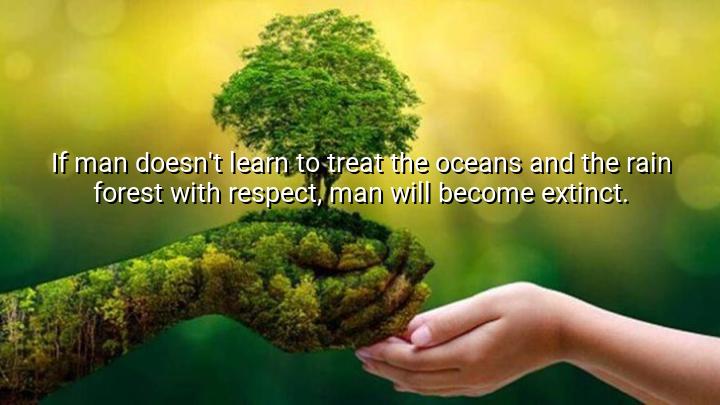




The quote "If man doesn't learn to treat the oceans and the rain forest with respect, man will become extinct" by Peter Benchley underscores the critical importance of environmental conservation and the need for sustainability in the face of growing ecological challenges. Benchley, best known for writing Jaws, later became a strong advocate for ocean preservation and environmental issues. In this statement, he warns that human survival is intrinsically linked to the health of the oceans and rain forests, two vital ecosystems that regulate the planet's climate and support life on Earth. If humanity continues to exploit and disrespect these natural resources, it risks its own extinction.
Benchley’s words highlight the need for humans to adopt a more respectful and responsible approach to nature. The oceans and rain forests are not just beautiful landscapes; they play essential roles in maintaining biodiversity, climate regulation, and carbon sequestration. Disrespecting these ecosystems—whether through deforestation, pollution, or overexploitation—can have devastating consequences, not only for the environment but for humanity itself. Benchley suggests that humans must evolve to become better stewards of the Earth if they hope to thrive in the long term.
The origin of this quote stems from Benchley’s later years, when he shifted his focus from fiction writing to environmental activism. After the success of Jaws, he became more deeply concerned about the destruction of marine life and the broader ecological crisis. His activism, particularly around shark conservation and the preservation of oceans, informed his views on how humanity must rethink its relationship with the natural world. His advocacy, including his work with organizations like Oceanic Preservation Society, shaped this message of urgent environmental responsibility.
Ultimately, Benchley’s statement is a powerful reminder that humanity’s fate is bound to the health of the planet. The quote calls for a shift in perspective, urging individuals, governments, and industries to prioritize ecological conservation and to treat natural resources with the respect they deserve. If humans fail to act responsibly, the consequences could be catastrophic, not only for the environment but for human survival itself.

AAdministratorAdministrator
Welcome, honored guests. Please leave a comment, we will respond soon