

To be creative means to connect. It's to abolish the gap between the body, the mind and the soul, between science and art, between fiction and nonfiction.
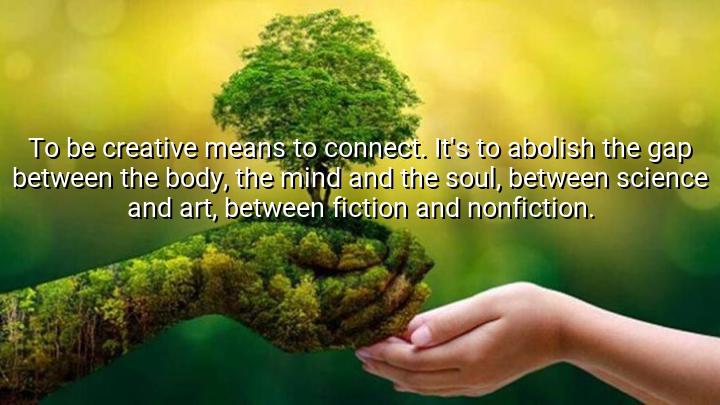




Nawal El Saadawi’s quote, "To be creative means to connect. It's to abolish the gap between the body, the mind and the soul, between science and art, between fiction and nonfiction," emphasizes the interconnectedness that lies at the heart of creativity. El Saadawi, an Egyptian writer and activist, suggests that true creativity arises when individuals break down the boundaries that traditionally separate different aspects of human experience. Creativity, in her view, is not about isolated processes but about forming connections across seemingly distinct domains.
The phrase "abolish the gap between the body, the mind and the soul" highlights the holistic nature of creativity. El Saadawi believes that to be truly creative, one must integrate all aspects of the self—physical, intellectual, and spiritual—to create work that is deeply authentic and meaningful. This idea reinforces the notion that creativity is not just an intellectual exercise, but something that involves the entire being, reflecting a deep connection between thought, feeling, and action.
By stating that creativity bridges the divide between science and art, as well as between fiction and nonfiction, El Saadawi underscores the idea that these fields are not mutually exclusive but can complement and inform each other. Science and art often appear to be at odds, with one focusing on logic and fact, and the other on emotion and imagination. However, El Saadawi suggests that creativity thrives when these boundaries are dissolved, allowing for a fuller expression of human experience that encompasses both rational and emotional understanding.
Ultimately, El Saadawi’s quote presents creativity as a unifying force, one that brings together disparate elements of life and thought. For her, the act of creating is a way of harmonizing these different aspects—whether they be intellectual, physical, or emotional—to produce something greater than the sum of its parts. It challenges us to think beyond traditional boundaries and to embrace the connections that lie at the heart of human expression.

HVThi Thu Hoai Vo
I admire the depth of this quote, but it makes me question how we define creativity. Is it about producing something new, or is it more about cultivating understanding and unity—both internally and across disciplines? The idea that connecting fiction with nonfiction and science with art is essential to creativity really broadens the concept. It makes me wonder if true creativity is actually more about synthesis than originality.
RHRi Ha
This quote really hit home for me, especially the part about connecting body, mind, and soul. In a world that often feels fragmented, creativity as a unifying act feels almost revolutionary. But I also wonder: can everyone access this kind of integrative creativity, or is it a privilege afforded to those with time, education, or emotional stability? How can more people be empowered to connect in this way?
NKCao Nguyet ky
I’m fascinated by the holistic view of creativity here. It challenges the traditional image of the lone genius working in isolation. Instead, this quote suggests creativity is a unifying force that requires openness and interconnectedness. Do you think society rewards this type of integrative thinking enough, or is it still biased toward specialization and labels? How can we make more room for this kind of boundary-crossing expression?
TPThao Phuong
I'm curious—what does it actually look like to bridge the gap between fiction and nonfiction, or science and art, in creative work? Are there examples where someone has successfully blended all those elements into something cohesive and powerful? This quote makes me want to rethink boundaries and try to be more fluid in my own work. But it also sounds incredibly challenging. Where does one even start?
VQNguyen Van Quang
This quote resonates deeply, but it also makes me ask: is true creativity possible without a sense of internal harmony? If someone feels disconnected from their body or emotions, does that limit their ability to create meaningfully? I appreciate how El Saadawi emphasizes wholeness. Maybe that’s why so many great artists and scientists talk about intuition and embodiment—things we usually don’t associate with rational thought.