

A lot of women are afraid of loneliness, so when they see a woman who can live alone, then they think, 'Hmm, I can do that.' But you need an example, and that is why I am proud to say I have divorced three husbands.
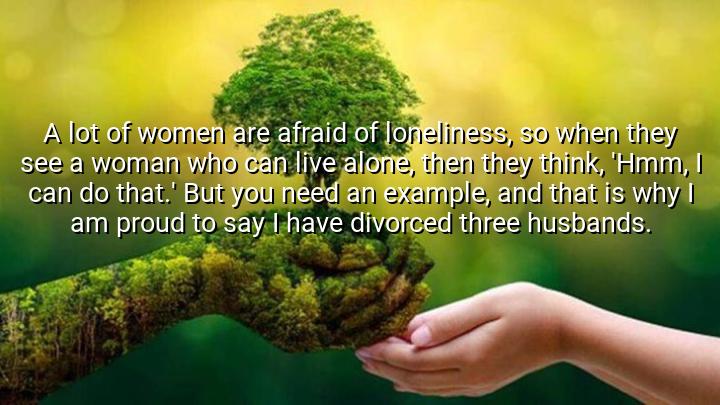




The quote "A lot of women are afraid of loneliness, so when they see a woman who can live alone, then they think, 'Hmm, I can do that.' But you need an example, and that is why I am proud to say I have divorced three husbands." by Nawal El Saadawi speaks to the societal pressures and expectations placed on women, especially regarding relationships and independence. El Saadawi suggests that many women are afraid of being alone because of cultural norms that often associate a woman’s worth with her relationship status. However, by living independently and setting an example, she shows that it is possible for women to lead fulfilling lives without being defined by their marital status.
The quote also highlights the concept of empowerment and self-reliance. El Saadawi is proud of her decisions and the ability to live life on her own terms, even if that means challenging traditional ideas of marriage and relationships. Her three divorces symbolize her refusal to stay in situations that don't serve her well, demonstrating her autonomy and strength in choosing to live independently rather than enduring an unhappy relationship.
Moreover, El Saadawi underscores the importance of having role models and examples to look up to. For many women, seeing others who are independent and unafraid to be alone can provide the confidence to break free from societal constraints. She suggests that by openly sharing her own experiences, including her divorces, she offers a form of empowerment to others, showing that it is possible to live a fulfilling life without being dependent on a partner.
The origin of this quote comes from Nawal El Saadawi, an Egyptian feminist, writer, and activist who is known for her outspoken advocacy for women's rights and her critiques of patriarchy and gender inequality in Arab society. Throughout her career, El Saadawi has used her personal experiences and writings to challenge traditional norms and promote the empowerment of women, especially through the lens of independence and self-determination. Her statement about divorce and loneliness reflects her broader commitment to encouraging women to live on their own terms and not to fear independence.

NKNguyen Khuong
El Saadawi’s statement strikes me as an act of rebellion against traditional gender roles. It raises the issue of how women’s narratives are often controlled or silenced. How important is it for women to share their personal stories of divorce and independence publicly? Could this visibility inspire systemic changes in laws, social policies, or cultural attitudes that better protect women’s rights and choices?
HNHuong Nguyen
The quote brings up an interesting question about the cultural differences in how divorce and living alone are perceived. In some societies, divorce is taboo, while in others it’s more accepted. What impact does this have on women’s ability to embrace independence? Also, how do economic factors influence the feasibility of living alone after divorce? Is financial security a bigger barrier than emotional fear of loneliness?
TNThanh Nguyen
Reading this, I feel a mix of admiration and curiosity. El Saadawi’s pride in her divorces highlights a powerful statement about self-worth. But I wonder about the emotional challenges that come with breaking social conventions. How do women navigate feelings of guilt or societal backlash when choosing to live alone or leave marriages? Could more open conversations about these experiences reduce stigma and promote mental well-being?
QMBui Quang Minh
This quote really challenges the stigma around divorce and the notion that women need to be in relationships to be complete. I wonder if having visible role models who embrace independence can truly shift public perceptions. How might communities create safer environments for women to choose their paths without fear of isolation? And how does this courage affect younger generations’ attitudes towards marriage and personal freedom?
CNMai chi Nguyen
Nawal El Saadawi’s boldness in embracing her divorces as a form of empowerment is refreshing. It makes me think about how societal pressures often trap women in unhappy relationships out of fear of loneliness. How can we better support women to find strength in solitude without judgment? Also, what role do cultural and social norms play in shaping women’s views on marriage and independence in different parts of the world?