

Women in most countries have not achieved much, because they can't be liberated under the patriarchal, capitalist, imperialist and military system that determines the way we live now, and which is governed by power, not justice, by false democracy, not real freedom.
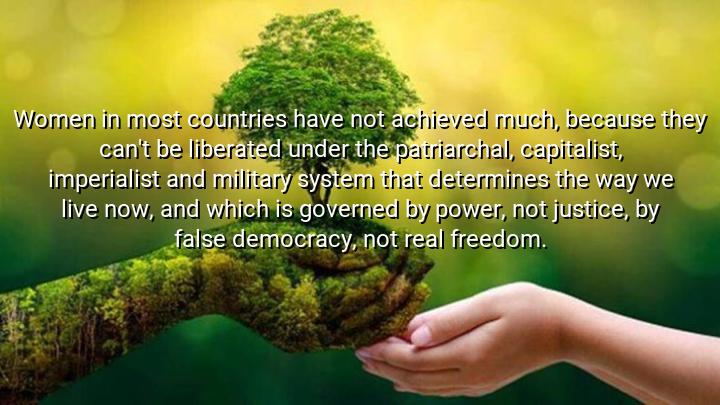




In this quote, Nawal El Saadawi critiques the systems of patriarchy, capitalism, imperialism, and militarism that she believes limit the progress of women worldwide. She argues that these systems are deeply embedded in society, shaping not only the political and economic landscapes but also the social structures that hinder women’s true liberation. According to El Saadawi, these systems uphold power dynamics that prioritize control over equality, leaving women unable to achieve their full potential or gain true freedom.
El Saadawi's perspective highlights the intersectionality of oppression, where different forms of dominance—patriarchal norms, capitalist exploitation, and imperialist agendas—work together to suppress women. She points out that real democracy and freedom cannot exist under these systems, as they are governed by a system of power that favors certain groups while marginalizing others. The false appearance of democracy, in her view, only serves to perpetuate inequality and prevent meaningful social change, particularly for women.
The quote also reflects El Saadawi's deep commitment to social justice and feminism, as she calls for a fundamental transformation of the systems that oppress not only women but other marginalized groups as well. For her, true liberation requires dismantling these structures and creating a more equitable society where power is distributed justly, and where all individuals, regardless of gender, have the freedom to live their lives without constraints imposed by dominant power structures.
Ultimately, El Saadawi's words challenge the status quo and urge a rethinking of how society is structured. She advocates for the pursuit of real freedom and justice, where the systems of oppression are replaced with ones that empower all individuals. Her critique highlights the urgency of addressing not just gender inequality but the broader systems of power that shape the global order.

AAdministratorAdministrator
Welcome, honored guests. Please leave a comment, we will respond soon