

May we think of freedom, not as the right to do as we please, but as the opportunity to do what is right.
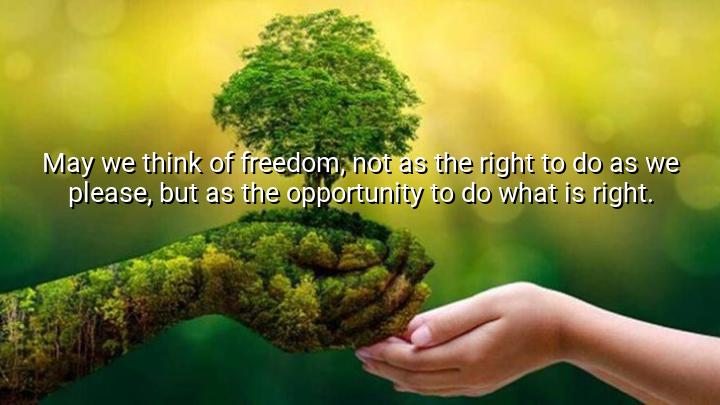




In this quote, Peter Marshall redefines the concept of freedom by suggesting that it should not be viewed as the right to do whatever we desire, but rather as the opportunity to act in a way that is morally right. He emphasizes that true freedom is not about indulging in selfish or irresponsible actions, but about having the ability to make choices that align with ethical principles and the greater good. Marshall’s definition highlights the responsibility that comes with freedom, emphasizing that with freedom comes the duty to make decisions that contribute to the well-being of society.
Marshall contrasts the common view of freedom as mere license—the ability to act without restraint or consequences—with a more responsible and moral interpretation. He suggests that real freedom is about making the right choices even when it is difficult, as opposed to simply acting on impulse or desire. This view of freedom is more aligned with the idea of accountability and self-discipline, where one uses their freedom to enhance their personal integrity and contribute positively to the community.
The quote also speaks to the idea that freedom is not an absolute right without limits, but one that must be exercised within the framework of moral and ethical standards. It implies that true freedom is found in the ability to act in harmony with a higher moral code, where individual liberty is balanced with the responsibility to do what is right for others. Marshall suggests that the measure of freedom should be based on virtue and justice, not merely personal gratification.
Ultimately, Marshall’s quote calls for a deeper understanding of freedom—one that involves not just the ability to do as we please, but the opportunity to make choices that reflect our values and contribute to the greater good. This perspective on freedom encourages individuals to think beyond themselves and to recognize that true liberty is connected to living with purpose and integrity.

AAdministratorAdministrator
Welcome, honored guests. Please leave a comment, we will respond soon