

The principles of true art is not to portray, but to evoke.
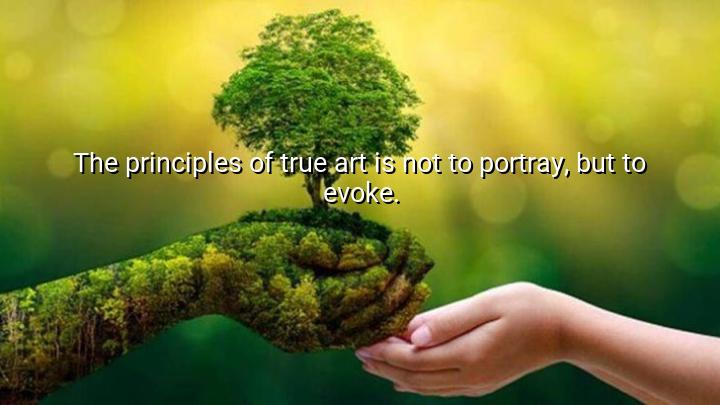




The quote "The principles of true art is not to portray, but to evoke" by Jerzy Kosinski suggests that the true essence of art lies not in mere representation but in its ability to stir emotions, thoughts, and experiences within the viewer. Kosinski emphasizes that art should not simply capture a likeness or a scene, but rather provoke deeper responses that resonate on a more personal and emotional level.
By choosing the word evoke, Kosinski shifts the focus from depiction to inspiration. Art in his view is not a passive reflection of reality but an active engagement that elicits feelings, memories, or reflections in the observer. The role of the artist, then, is to create something that sparks an internal reaction, inviting the audience to interpret and connect with the work beyond its surface.
The origin of this quote is tied to Kosinski's broader philosophy about art and literature, where he often explored the idea that the most powerful works are those that trigger personal experiences or emotional connections. As a writer and artist, he believed that art should transcend simple representation and reach into the core of human experience, prompting reflection and engagement.
Kosinski's belief in evocation over portrayal challenges traditional notions of art as a tool for accurate representation, encouraging artists to focus on the transformative power of their work. By evoking rather than portraying, art becomes a catalyst for emotional or intellectual exploration, offering a deeper connection between the artwork and the viewer.

PLTran thi phuong linh
I have mixed feelings about this quote. On one hand, the idea of art being a catalyst for emotional or intellectual reaction feels powerful and liberating. On the other hand, is there a danger in abandoning representation completely? Especially when considering art as a historical or cultural record. Can evocation exist without some tether to portrayal? Or is the act of evoking in itself a kind of portrayal, just less literal?
MTMinh Truong
As someone who enjoys photography, I find this quote fascinating. It makes me think about the difference between taking a technically perfect shot versus capturing something that moves people emotionally. Is the goal to replicate what’s in front of you, or to communicate an unseen truth or feeling? Kosinski's words feel like a call to deeper authenticity and expression, but I wonder how much of that depends on the viewer’s emotional openness.
TNTran Thao Nhi
Kosinski’s quote makes me think of abstract and surrealist art. Those styles seem to prioritize evoking a feeling or concept over depicting reality. But is there a risk of becoming too ambiguous? Can evocation without some grounding lead to disconnection from the audience? I find myself torn—while I appreciate emotional power in art, I also find comfort in clarity and structure. Is there a balance between the two?
NLNhung Le
I love the idea of art being about evocation rather than portrayal—it feels so much more intimate and subjective. But then, how do we measure its success? If one person is deeply moved and another feels nothing, is the work effective or not? This makes me think art isn't about universal truth but about personal resonance. Still, I wonder if this approach undervalues the importance of craftsmanship and detail.
GDGold D.dragon
This quote really challenges the conventional expectations placed on art. If art isn't about accurate representation but about stirring emotion or thought, does that mean technical skill becomes secondary to emotional impact? I wonder how this applies across different mediums—like literature, film, or sculpture. Is the artist's intent still central, or is it more about the viewer's interpretation? It definitely reframes the purpose of creating and experiencing art for me.