

I look back into past history, the stored experiences or products of the imagination. I look no further forward than the evening.
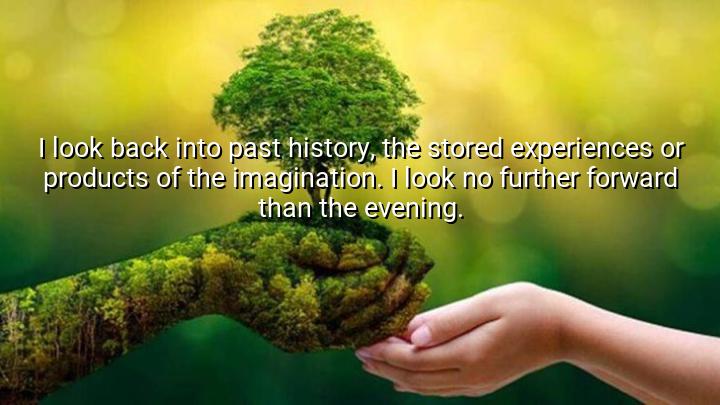




The quote "I look back into past history, the stored experiences or products of the imagination. I look no further forward than the evening" by Jerzy Kosinski reflects a perspective focused on the present and the influence of the past on how one lives in the moment. Kosinski, a Polish-American novelist known for his explorations of identity, history, and personal experience, seems to suggest that while the past—both real and imagined—shapes who we are, our focus should remain on the present, perhaps avoiding the anxiety of what lies ahead. His acknowledgment of looking "no further forward than the evening" conveys a sense of mindfulness and acceptance of the immediate moment.
In this context, Kosinski contrasts history and imagination, where the past becomes a repository of memories and learned experiences, while the imagination allows for the interpretation and creation of meaning from those experiences. His quote suggests that imagination, informed by history, allows us to reflect on what has been, yet it is important to limit projections about the future, which often remain uncertain and out of our control. The reference to only looking "as far forward as the evening" emphasizes the idea of living in the now, finding contentment in the immediate present rather than focusing on distant, often unknowable, outcomes.
The origin of the quote connects with Kosinski’s broader themes of existential reflection and the search for meaning within individual experiences. In his works, such as The Painted Bird, Kosinski often portrayed characters struggling with trauma and the weight of history, examining how these elements shape personal identity. This quote encapsulates his viewpoint that while we cannot escape the past, we must not let it determine the future, encouraging a balance between acknowledging history and living fully in the present.
Ultimately, Kosinski's quote suggests a deeply reflective and practical approach to life. By drawing on the past for understanding and insight, but limiting the focus on the future, we can live more intentionally and authentically. It emphasizes the importance of presence, finding peace in the moments we live now, rather than being consumed by what has already happened or the uncertainties of what is yet to come.

AAdministratorAdministrator
Welcome, honored guests. Please leave a comment, we will respond soon