

The five stages - denial, anger, bargaining, depression, and acceptance - are a part of the framework that makes up our learning to live with the one we lost. They are tools to help us frame and identify what we may be feeling. But they are not stops on some linear timeline in grief.
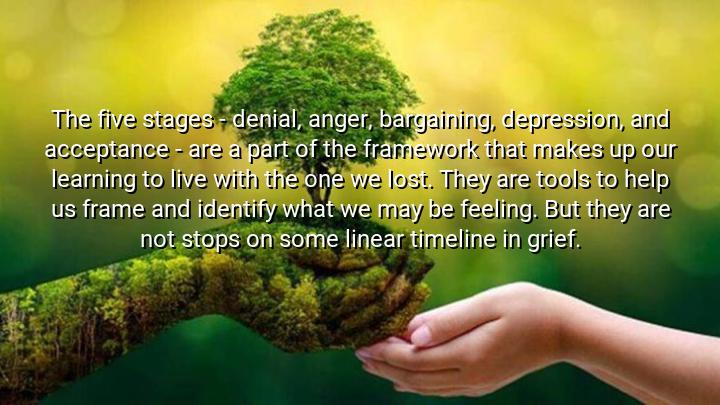




In this quote, Elisabeth Kübler-Ross clarifies that the five stages of grief—denial, anger, bargaining, depression, and acceptance—are not rigid or linear steps that everyone goes through in a specific order after a loss. Instead, they are part of a framework that helps individuals navigate their emotions and better understand what they are feeling as they cope with the death of a loved one. These stages are meant to be tools for self-reflection and emotional processing, but they should not be viewed as a prescribed path to healing.
Kübler-Ross’s statement emphasizes the non-linear nature of grief. People may move back and forth between these stages, or experience them in a completely different order. For example, a person might experience anger before experiencing denial, or they may find themselves revisiting certain emotions like bargaining or depression long after they feel they have reached acceptance. This reflects the complexity and individuality of the grieving process, where there is no “right” way to grieve.
The origin of this quote comes from Kübler-Ross's groundbreaking work on death and dying, particularly her book On Death and Dying, where she first introduced the concept of the five stages. She initially developed the stages based on her work with terminally ill patients, but over time, her theory expanded to encompass the broader experience of loss. Her work revolutionized the understanding of grief and highlighted the importance of recognizing and acknowledging emotional reactions to death.
Ultimately, Kübler-Ross’s quote serves as a reminder that grief is a personal and unique journey. It encourages individuals to embrace the full range of emotions that arise after a loss and understand that these feelings are not bound by a timeline or sequence. Grief is fluid, and the stages of denial, anger, bargaining, depression, and acceptance can evolve and shift, offering different insights and healing over time.

Bbucugianghoa
The idea that the stages of grief are not sequential offers hope and flexibility in coping with loss. How might this inform the way friends and family offer support? Could embracing this fluidity reduce pressure on the bereaved to ‘act’ a certain way? I wonder if this perspective could also help healthcare providers tailor their care to individual emotional journeys more effectively.
HLHong Le
Reading this made me reflect on how difficult it is to put feelings into neat categories. If grief isn’t a timeline, how do we know when healing is happening or when someone needs help? Does this approach risk making grief feel endless, or does it offer freedom from unrealistic expectations? It’s a comforting yet challenging perspective to hold.
NName
This statement invites a deeper conversation about how we teach and talk about grief in society. Are the five stages too rigidly presented in popular culture? How could framing them as tools rather than fixed milestones change how people approach mourning? It also raises the question: what other emotional frameworks might complement or expand on this model to capture the complexity of loss?
NTNgoc Trinh
I appreciate this nuanced take on the five stages of grief because it validates that feelings can be messy and overlapping. Does this mean that people might cycle through stages multiple times or even experience several simultaneously? How can this understanding improve support systems like counseling or support groups to better accommodate varied grief experiences?
BKBang Khanh
This quote challenges the common misconception that grief follows a strict, linear path. It makes me think about how individualized and unpredictable the grieving process truly is. How might understanding grief as a non-linear experience help people be more patient with themselves and others? Could this perspective reduce feelings of guilt or inadequacy when someone doesn’t ‘move on’ in the expected timeframe?