

I know beyond a shadow of a doubt that there is no death the way we understood it. The body dies, but not the soul.
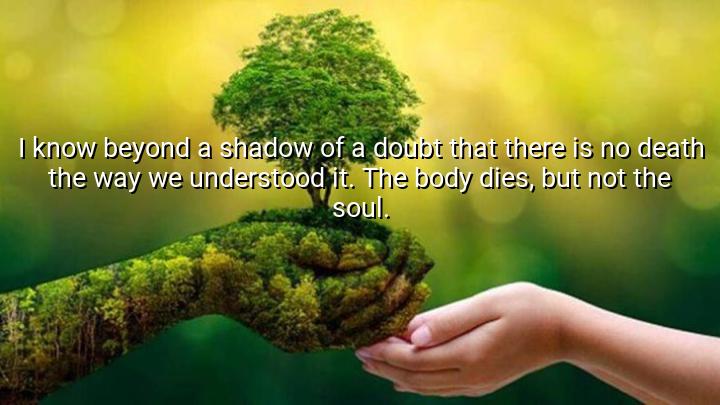




The quote "I know beyond a shadow of a doubt that there is no death the way we understood it. The body dies, but not the soul" by Elisabeth Kubler-Ross reflects her beliefs about the nature of life and death, particularly as she explored it in her work on death and dying. Kubler-Ross, a psychiatrist known for her pioneering work in the field of hospice care and for developing the five stages of grief, emphasizes the distinction between the physical body and the soul. She suggests that while the body may cease to exist, the soul, or the essence of a person, continues on in some form beyond physical death.
Kubler-Ross’s perspective challenges traditional views of death as a final, absolute end, instead proposing a more spiritual understanding of existence. She believed that death is not the ultimate termination of a person's being but rather a transition from one form of existence to another, where the soul remains intact and eternal. This view aligns with many spiritual and philosophical traditions that see the soul as imperishable, offering comfort to those who fear the finality of death.
The origin of this quote comes from Kubler-Ross's extensive work with terminally ill patients and her deep exploration of the emotional and spiritual aspects of dying. In her landmark book On Death and Dying, she discussed how individuals often experience death not just physically but emotionally and spiritually, leading her to the conclusion that the soul lives beyond the physical death of the body. Her work revolutionized the way people approached end-of-life care and grief, offering compassion and a more holistic view of human existence.
Ultimately, Kubler-Ross's quote invites us to reconsider our understanding of death. By emphasizing the enduring nature of the soul, she offers a comforting perspective that transcends the fear of physical death, proposing that what makes us truly alive—our spirit or essence—continues beyond the end of the body.

AAdministratorAdministrator
Welcome, honored guests. Please leave a comment, we will respond soon