

The enemy of art is the absence of limitations.
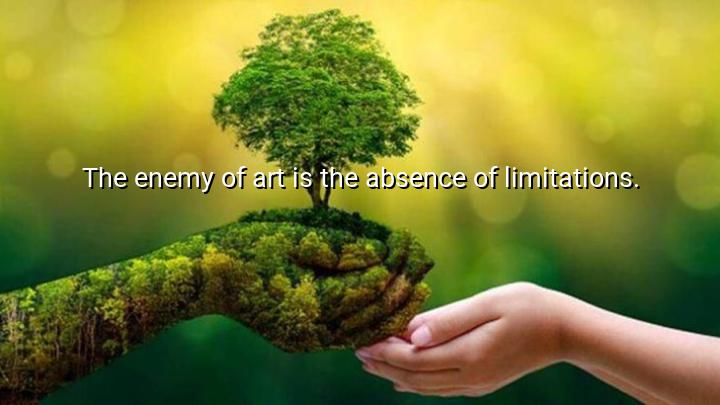




The quote "The enemy of art is the absence of limitations" by Orson Welles explores the idea that true creativity and artistic expression thrive within boundaries. Welles, a legendary filmmaker and actor known for works like Citizen Kane, suggests that constraints—whether they be technical, financial, or conceptual—are not hindrances but rather essential components of the artistic process. Without limitations, there is no challenge, and art loses its drive to innovate or find unique solutions.
Welles argues that limitations force artists to think more creatively, finding new ways to express their ideas within the confines they face. For example, a filmmaker working with a small budget may be pushed to develop inventive techniques and storytelling methods, while an artist working within a specific medium may explore its potential in more depth. These limitations encourage artists to push boundaries, resulting in works that are more authentic, thoughtful, and innovative.
The absence of limitations could lead to a lack of structure or purpose in art, making it difficult for creators to focus or develop a distinctive vision. In Welles’ view, when there are no constraints, the creative process becomes less about overcoming challenges and more about unlimited possibilities, which can lead to a dilution of impact or originality. Therefore, limitations serve as a catalyst for innovation and meaningful creation.
In essence, Welles’ quote emphasizes that limitations are not obstacles to art, but rather its driving force. It is through the challenge of working within boundaries that art finds its power, uniqueness, and depth. Without these constraints, the creative process may lose its direction and urgency, leading to a less meaningful or engaging outcome.

TTVu Thu Trang
Does this idea apply to modern content creation? Today, creators have unprecedented freedom—platforms, tools, global audiences. Yet much of it feels formulaic. Could it be that too many choices make us lazy or repetitive? Maybe that’s why challenges like ‘Inktober’ or 'flash fiction' thrive—they impose a limit, and that tension drives originality. Is that why constraints in art often feel more authentic than unconstrained abundance?
ATLe Thanh Anh Tuan
I agree with Welles in theory, but I think this idea can be romanticized. Constraints can be a crucible for creativity, yes, but only if they’re not crippling. An artist without time, money, or support might never get to create at all. So how do we differentiate between limitations that inspire and those that silence? This quote opens a powerful discussion on privilege and access in the art world.
ACAnh Chu
It’s such a bold claim, and yet it makes sense when you think about minimalism, haiku, or silent films—where limits shaped timeless art. Could it be that having fewer options forces artists to dig deeper into their vision? But what about the fear that some voices never emerge because the wrong limitations are in place—like social inequality or lack of access? Not all constraints are fertile ground.
VTNguyen Viet Thien
I find this quote a bit paradoxical. Aren’t artists often trying to break free from limitations—like censorship, budget, or tradition? But maybe the point is that limitations force clarity and decision-making. Without boundaries, there’s no friction to push against. Still, I’m curious: are all limitations equally valuable? Are some more stifling than inspiring? Where's the line between helpful constraint and creative suffocation?
VTVan Thanh
Welles’ quote makes me wonder how much of today’s digital art suffers because of limitless tools. With AI, unlimited storage, and boundless software options, do artists lose their edge? Maybe too much freedom dilutes intention. Is there a case for imposing artificial constraints to push originality—like writing a story in just six words or painting with only one color? Could limitations be a necessary ingredient for authentic expression?