

I have a great love and respect for religion, great love and respect for atheism. What I hate is agnosticism, people who do not choose.
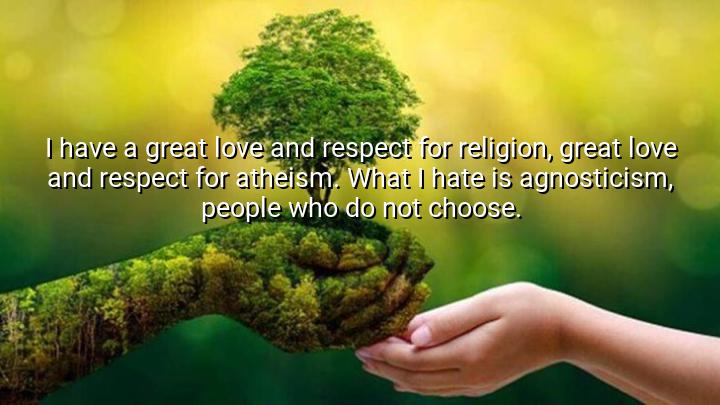




Orson Welles’ quote expresses his deep respect for both religion and atheism, but he takes issue with agnosticism, particularly with individuals who do not make a clear choice regarding their beliefs. Welles contrasts the certainty and conviction of religious faith and atheism, where individuals commit to a particular worldview, with the indecision he associates with agnosticism. He suggests that agnostics, by not committing to either belief system, are avoiding the responsibility of choosing a side in the debate about belief and non-belief.
The quote reflects Welles’ admiration for those who are willing to take a definitive stand, whether for or against the existence of a higher power. To Welles, agnosticism represents a lack of commitment, perhaps out of fear or uncertainty, which he finds unsatisfactory. His disdain for agnosticism speaks to a larger theme in his philosophy: the importance of making decisions and standing firm in one’s beliefs, rather than remaining in a state of ambiguity or indecision.
Welles’ personal views on religion and atheism were complex and evolved over time. He often expressed a deep appreciation for the mystical and philosophical elements of religious traditions, while also maintaining a skeptical and critical stance toward organized religion. His quote highlights the tension between faith and doubt, suggesting that both sides of the argument require conviction and clarity—qualities he believed were lacking in those who took a middle ground.
Originating from Orson Welles, a renowned filmmaker, actor, and thinker, the quote reflects his intellectual approach to life's big questions. Welles was known for his boldness in both his work and his views on various subjects, including philosophy, politics, and human nature. His passion for clarity and commitment to ideas came through in his works, where he often explored themes of identity, truth, and existential choice.

AAdministratorAdministrator
Welcome, honored guests. Please leave a comment, we will respond soon