

Now I'm an old Christmas tree, the roots of which have died. They just come along and while the little needles fall off me replace them with medallions.
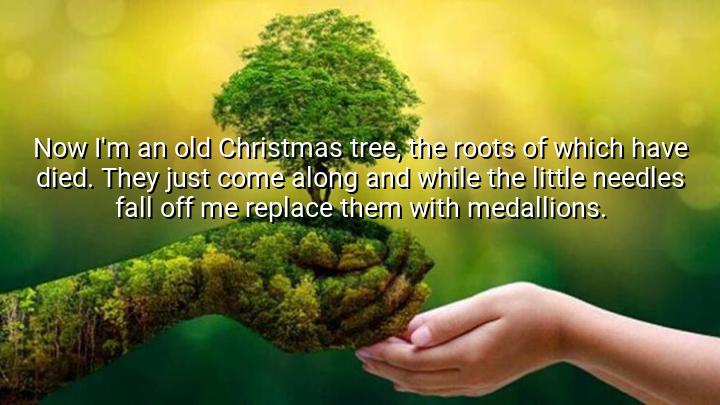




The quote "Now I'm an old Christmas tree, the roots of which have died. They just come along and while the little needles fall off me replace them with medallions." by Orson Welles uses a powerful metaphor to reflect on his own sense of aging and the process of being perceived in a new light as time passes. Welles compares himself to an old Christmas tree, with the roots (representing his original self or foundation) having died, symbolizing his feeling of being disconnected from his past or the essence of who he once was. The image of the tree losing its needles suggests that Welles feels he is losing parts of his former vitality, while the medallions represent superficial decorations or changes that are made to mask the loss, rather than address it deeply.
The metaphor of being like a Christmas tree also connects to the idea of being decorated or adorned by others, particularly when someone’s natural essence has faded or been overlooked. Just as a Christmas tree, once its needles fall, is replaced with decorative medallions to keep up appearances, Welles may be commenting on how society or the public continues to honor him for his image or past achievements, even as his true self or roots feel neglected or diminished. The quote implies a sense of loss and alienation, suggesting that as he ages, he is more of a symbol than a living entity with emotional depth.
The quote also reflects Welles’ complex feelings about his legacy and how he may feel as though his public persona has been replaced with superficial praise, such as the medallions, while the essence of who he was in his youth—his creativity, energy, and vision—has faded or been forgotten. The image of the tree losing its needles and being decorated with medallions conveys the idea of being propped up by others rather than being allowed to exist authentically.
Ultimately, Welles' statement reflects the melancholy that can accompany aging, fame, and the passage of time. His comparison of himself to an old Christmas tree is both an expression of sadness and a sharp commentary on how society often values people for their image or achievements rather than their true, internal selves. It speaks to the human experience of grappling with the loss of youth and the way in which people are sometimes celebrated for what they once were rather than who they are now.

AAdministratorAdministrator
Welcome, honored guests. Please leave a comment, we will respond soon