

When the missionaries came to Africa they had the Bible and we had the land. They said 'Let us pray.' We closed our eyes. When we opened them we had the Bible and they had the land.
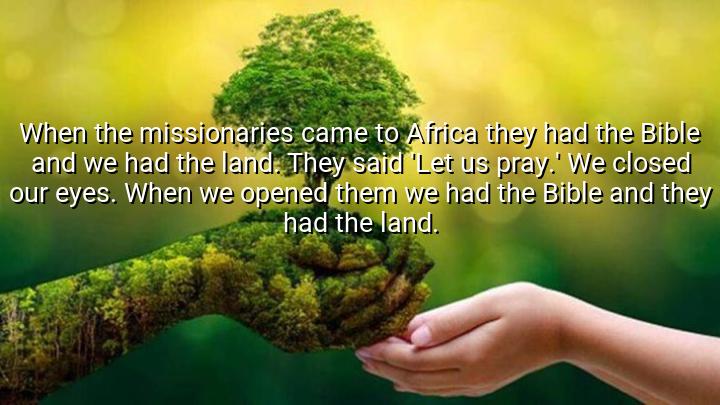




The quote by Desmond Tutu, "When the missionaries came to Africa they had the Bible and we had the land. They said 'Let us pray.' We closed our eyes. When we opened them we had the Bible and they had the land," reflects the historical impact of colonialism, religion, and power dynamics in Africa. Tutu highlights how European missionaries, under the guise of spreading Christianity, often facilitated land dispossession and cultural domination. The quote underscores the ways in which faith was intertwined with control, turning spiritual influence into a tool for colonial exploitation.
The origin of the quote comes from Desmond Tutu, a South African archbishop and social rights activist, known for his work in anti-apartheid movements and human rights advocacy. Tutu frequently spoke about the intersection of faith and justice, using his platform to critique historical and contemporary injustices. This statement reflects his awareness of the complex legacy of missionary work in Africa and the consequences of colonial encounters masked as benevolence.
At its core, the quote conveys a powerful lesson about awareness and vigilance. Tutu emphasizes that even well-intentioned spiritual or moral missions can have profoundly exploitative outcomes when combined with political or economic agendas. It reminds audiences that power, land, and resources are often at stake in historical interactions, and that cultural and material loss can be subtle but enduring.
Ultimately, this quote serves as both a historical reflection and a cautionary observation. Tutu underscores the need to critically examine the intersection of religion, power, and colonial history, highlighting the importance of recognizing how authority and influence can be wielded to reshape societies and claim what is not rightfully one’s own. It remains a resonant critique of injustice and exploitation.

AAdministratorAdministrator
Welcome, honored guests. Please leave a comment, we will respond soon