

The ego mind both professes its desire for love and does everything possible to repel it, or if it gets here anyway, to sabotage it. That is why dealing with issues like control, anger, and neediness is the most important work in preparing ourselves for love.
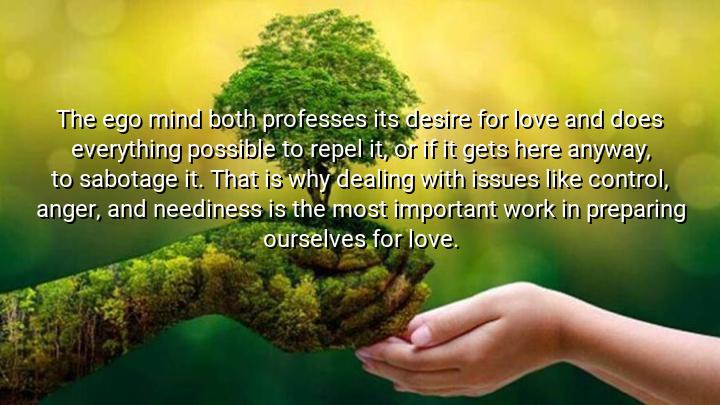




In this quote, Marianne Williamson delves into the complex nature of the ego mind and its paradoxical relationship with love. She suggests that while the ego desires love, it simultaneously works to repel it or sabotage it when it does appear. The ego, driven by fears, insecurities, and the desire for control, often creates barriers that prevent genuine emotional connection. Even when love comes into our lives, the ego can distort it, causing self-sabotage and emotional resistance to receiving or giving love freely.
Williamson emphasizes that in order to prepare ourselves for true love, we must address and overcome internal issues such as control, anger, and neediness. These emotional obstacles are often rooted in the ego’s fear of vulnerability and its desire to protect itself from perceived threats. By working through these challenges, individuals can clear the way for authentic love to enter their lives without the interference of unresolved emotional baggage.
The origin of this quote is rooted in Williamson's teachings on personal growth, spirituality, and relationships. As an author and spiritual teacher, Williamson has long focused on the transformative power of love and its role in healing emotional wounds. Her work often draws on spiritual principles, particularly those from A Course in Miracles, which emphasizes the importance of love as a healing force and the need to transcend the ego's limitations.
Ultimately, Williamson’s quote serves as a reminder that the ability to fully receive and give love requires self-awareness and emotional healing. By addressing the ego's tendencies toward control, anger, and neediness, individuals can cultivate an open, compassionate heart that is truly capable of experiencing unconditional love. This process, she suggests, is essential for deep, meaningful connections in both romantic and interpersonal relationships.

LMLe manh
Reading this, I’m curious about the balance between the ego and authentic self in love. Is the goal to eliminate the ego completely or to integrate it healthily? How do mindfulness or spiritual practices assist in this process? It seems like a profound reminder that self-work is fundamental to experiencing genuine love.
GHDoan Gia Han
This statement highlights the importance of emotional preparation before fully embracing love. How might acknowledging and healing from anger or neediness prevent destructive patterns? Also, could societal pressures and past traumas exacerbate ego defenses? Exploring this could shed light on why some people repeatedly struggle to maintain loving connections.
TTAnh Thu Tran
The idea that the ego repels love despite craving it resonates with many personal experiences. I wonder how much of relationship conflict stems from these internal struggles rather than external circumstances. Can couples work together to overcome ego sabotage, or is this primarily an individual journey? It feels like understanding the ego’s role is key to healthier relationships.
VNNgoc Van Nguyen
I find this perspective insightful but challenging. Dealing with control, anger, and neediness sounds like intense inner work. Are there practical steps or therapies recommended to address these ego barriers? How do we know when we’re ready to love authentically, without the ego interfering? This invites reflection on emotional maturity and self-growth.
TNtran nguyen
This quote makes me think about the paradoxical nature of the ego and how it can sabotage our deepest desires. How often do people unknowingly push love away due to unresolved control issues or anger? It raises the question of self-awareness—how can one begin to recognize and dismantle these ego-driven behaviors to truly open up to love?