

The art of medicine consists in amusing the patient while nature cures the disease.
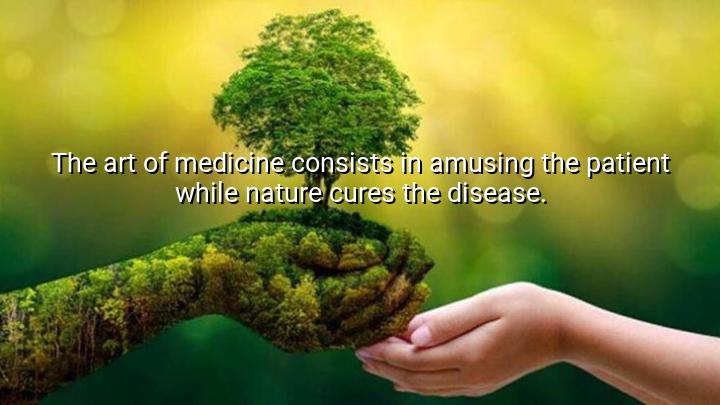




In this quote, Voltaire humorously critiques the role of medicine in healing by suggesting that the true art of medicine lies not in curing the disease directly, but in amusing the patient while nature does the actual work of healing. He implies that many medical treatments or interventions may be more about keeping the patient distracted or comforted, allowing the body’s own natural healing processes to take their course. Voltaire’s wit here challenges the idea that medical science alone is responsible for curing illness, pointing to nature as the primary force behind recovery.
The origin of the quote comes from Voltaire’s satirical approach to society, where he often critiqued various institutions, including religion, politics, and science. As a philosopher and writer during the Enlightenment period, Voltaire was deeply skeptical of the prevailing norms and authority of the time. His works, such as Candide, often poked fun at the human tendency to rely on systems and beliefs that were not always based on reason or empirical evidence. This quote reflects his view that many professions, including medicine, could be seen as providing comfort more than actual cure.
Voltaire’s statement also touches on the nature of healing itself. He suggests that the body’s innate ability to fight off illness and recover is often more important than any external intervention. The role of the doctor, in this sense, is less about directly curing the disease and more about providing support, relief, and reassurance to the patient. This view aligns with his broader philosophical perspective that reason and natural processes often play a greater role in life’s solutions than human interference.
Ultimately, this quote serves as a critique of the medical profession and the overconfidence that might come with medical treatments. Voltaire encourages a humble perspective, acknowledging that the power of nature should not be underestimated in the process of healing. By describing medicine as an art of providing comfort while nature does the work, he humorously highlights the limitations of human efforts in the face of the body’s own remarkable resilience and self-healing abilities.

HTDuong Hong Truong
I’m struck by how this quote subtly critiques the arrogance that can exist in medicine. If nature is the true healer, then are doctors facilitators rather than saviors? This challenges the 'hero complex' that some medical professionals may carry. Could Voltaire be advocating for a more humble view of the physician’s role—more companion than commander?
NNPhuong Linh 7A1 Nguyen Ngoc
Do you think Voltaire’s quote is still relevant in today's healthcare system? I’ve seen how important empathy and humor can be in hospital settings—it’s not just about the cure, but the experience of being ill. This makes me wonder: should medical training place more emphasis on emotional intelligence and communication skills rather than just diagnostics and procedures?
PTle phuoc tri
Honestly, this quote makes me chuckle because it’s so sharply observant. But I also feel like it’s outdated given how far medicine has come. With modern surgery, antibiotics, and therapies, can we really say nature does all the work? Or is Voltaire commenting on the limits of his era’s medicine? Maybe today, this quote is more relevant to holistic or palliative care than emergency medicine.
NTNguyen Thu
Voltaire’s perspective raises an interesting question: is the human body inherently self-correcting, and is the doctor’s role more about morale than medicine? It makes me think about how placebo effects work and why people often feel better after just seeing a doctor. Is there a danger in underestimating medicine, or is he simply highlighting that healing isn’t purely clinical—it’s emotional and psychological too?
QCQuang CT
I find this quote both witty and a bit cynical. It seems to mock the medical profession, implying that doctors merely distract us while our bodies do the real work. But isn’t there some truth to that? Especially with illnesses like colds or minor infections where rest and time are the real healers. How does this idea hold up with modern chronic diseases that truly require medical intervention?