

Such is the feebleness of humanity, such is its perversity, that doubtless it is better for it to be subject to all possible superstitions, as long as they are not murderous, than to live without religion.
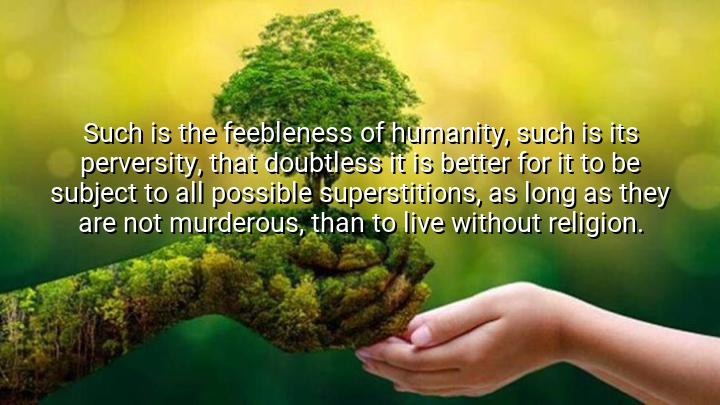




Voltaire’s quote reflects his cynicism about human nature and the role of religion in society. By stating, "Such is the feebleness of humanity, such is its perversity," Voltaire acknowledges the inherent weaknesses and flaws of mankind, implying that humans need a system of beliefs to maintain social order and personal morality. The suggestion that it is better for people to be "subject to all possible superstitions, as long as they are not murderous," highlights his view that even irrational or misguided beliefs may offer some benefit by providing structure and meaning, as long as they do not lead to violence or harm.
Voltaire's statement is also a critique of the human need for religion as a form of control or guidance, suggesting that without it, humanity might descend into chaos or moral decay. He contends that while superstitions may be illogical or unscientific, they serve a purpose in the lives of many people by giving them something to hold onto. However, he makes it clear that religion should not become a tool for violence or oppression, as the murderous consequences of fanatical beliefs have historically led to widespread suffering.
As a leading Enlightenment thinker, Voltaire often challenged organized religion and its influence on society. His skepticism about the institutionalized aspects of religion can be seen in his broader philosophical works, where he advocated for reason, freedom of thought, and tolerance. Yet, here, he paradoxically acknowledges that even superstition or belief in a higher power can have a stabilizing effect on society, provided it doesn't lead to harm.
The origin of this quote lies in Voltaire’s complex relationship with religion and his critique of both dogmatic beliefs and the role of religion in political power. As an advocate for secularism and reason, Voltaire saw religion as a necessary but flawed aspect of human life, which, if not carefully managed, could lead to both moral and social issues. This quote reflects his belief that faith—even if irrational—plays a crucial role in maintaining social stability, as long as it doesn't encourage violence or intolerance.

AAdministratorAdministrator
Welcome, honored guests. Please leave a comment, we will respond soon