

The art challenges the technology, and the technology inspires the art.
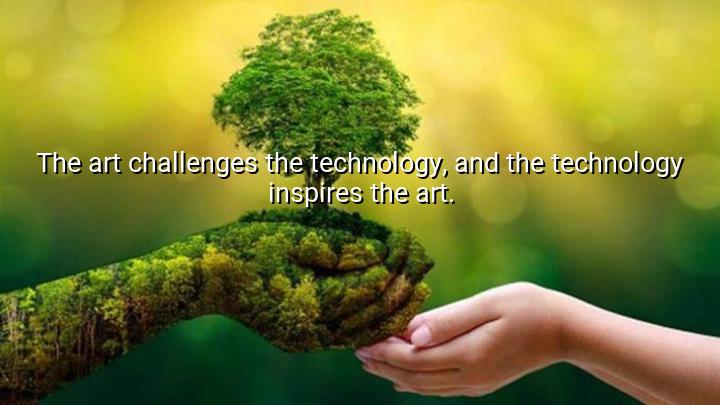




The quote "The art challenges the technology, and the technology inspires the art" by John Lasseter highlights the symbiotic relationship between creativity and innovation. It suggests that art can push the boundaries of technology, urging it to evolve and adapt in order to bring new ideas to life. Artists often encounter limitations in existing technologies, prompting them to explore new methods or tools that can better serve their creative visions.
On the other hand, technology plays a crucial role in shaping the direction of art. With advancements in fields like digital media, 3D printing, and virtual reality, technology provides artists with new possibilities and tools to express themselves in ways that were previously unimaginable. The availability of these innovative technologies can open up fresh avenues for artistic exploration and expression, inspiring artists to experiment with new forms and ideas.
John Lasseter, a pioneer in the field of animation and one of the founders of Pixar Animation Studios, is known for his belief in the intersection of technology and art. His work on groundbreaking animated films like Toy Story and Finding Nemo exemplifies how art and technology can collaborate to create something extraordinary. In this context, the quote serves as a reminder that both elements rely on each other for growth and progress.

PUTran Phuong Uyen
I'm fascinated by how Lasseter’s quote speaks to evolution. Historically, inventions like the camera or synthesizer totally changed the art landscape. Do you think AI is the next frontier in this conversation? Could AI become the 'technology' that both challenges and inspires, or is it something entirely new—something that might eventually replace the artist rather than collaborate with them?
TTLy Thu Thao
As a gamer, I see this relationship in every major title—stunning visuals that push hardware limits, and new hardware that opens up gameplay mechanics we never imagined. But sometimes I miss the simplicity of older games with basic graphics but rich storytelling. Is there a danger that technical flash can distract from—or even replace—emotional depth in artistic works?
PDQuyen Pham Dieu
I find this quote motivating, especially as someone who works in UX design. Every time we hit a technical limit, it sparks new design ideas—and vice versa. Do you think there’s a tipping point where that symbiotic relationship turns into dependency, though? Could the art become overly reliant on the next tech trend rather than staying rooted in meaningful expression?
AVAn Vlog
It’s inspiring to see the mutual push-pull dynamic between technology and art framed so positively. That said, I sometimes worry that not all artists have equal access to cutting-edge tools. Does this growing dependence on tech create a barrier for less-resourced creatives? Are we unintentionally limiting diverse artistic voices by letting the latest gadgets define the art scene?
BNBao Ngan
I really like this perspective because it feels true across so many fields—film, music, design, even fashion. But it raises a question for me: which should lead—art or technology? Are we at a point where technology dictates the limits of what art can be, rather than the other way around? What happens when the tech outpaces the artist’s ability to use it meaningfully?