

Some emotions are essential to law and to public principles of justice: anger at wrongdoing, fear for our safety, compassion for the pain of others, all these are good reasons to make laws that protect people in their rights.
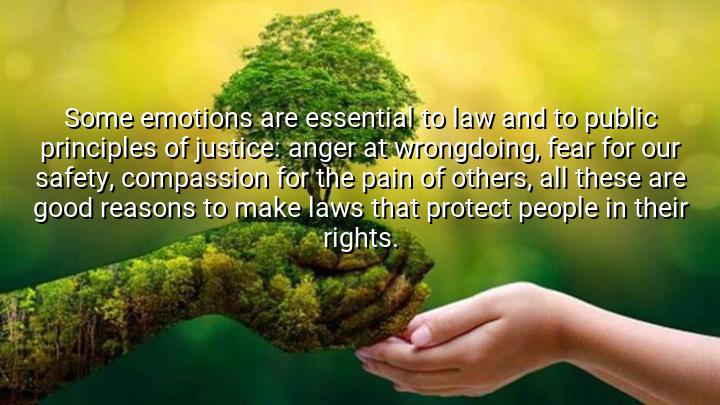




In this quote, Martha Nussbaum emphasizes the importance of emotions in shaping laws and the principles of justice. She argues that certain emotions, such as anger at injustice, fear for personal or collective safety, and compassion for the suffering of others, are not only natural but also vital to the creation of laws that protect people's rights. These emotions drive individuals and societies to advocate for legal systems that uphold fairness and safeguard the well-being of all citizens.
Nussbaum points out that anger at wrongdoing motivates people to demand accountability, while fear for safety compels societies to establish protective measures and legal frameworks. Compassion, on the other hand, encourages laws that address the needs of vulnerable populations and promote empathy within the legal system. By acknowledging the role of these emotions, Nussbaum argues that laws are deeply intertwined with human experiences and should reflect a society's moral concerns.
The origin of this quote likely stems from Nussbaum's work in philosophy and ethics, where she explores the relationship between emotions and moral reasoning. Her research often highlights the idea that emotions are not merely personal reactions but play a crucial role in shaping social justice and legal structures. In her view, emotions like anger and compassion are essential for motivating the creation of laws that protect and promote human dignity.
Overall, Nussbaum’s quote reflects her belief that emotions are foundational to a just society. Rather than being seen as disruptive or irrational, emotions are portrayed as powerful forces that help to build a more ethical and fair system of law. This perspective reinforces the idea that the law should be responsive to the emotional and moral needs of individuals, ensuring the protection of rights for all.

DHDuc Hieu
I appreciate the recognition of fear, anger, and compassion as legitimate influences on law. Does this mean that laws should evolve with societal emotions, or should they remain stable regardless of changing public sentiments? How do emotional appeals in legal debates impact policy outcomes? Nussbaum’s quote highlights the essential but delicate role emotions play in justice and law.
MMy
Nussbaum’s framing of emotions as drivers of public principles suggests a deeply human approach to justice. How do we ensure that emotions such as anger don’t lead to punitive laws, while compassion promotes rehabilitation? What mechanisms exist to balance emotional impulses with objective legal standards? This quote sparks important questions about the ethical foundation of our laws.
ATLe anh tu
This quote makes me think about how emotions are often viewed as irrational, yet here they are presented as crucial for justice. How might acknowledging emotions like compassion change the way laws are created and applied? Could this approach lead to more empathetic and effective legal systems? Nussbaum’s idea underscores the complexity of human motivation behind legal protections.
DTDo Truc
I find it insightful that Nussbaum recognizes emotions as essential motivators for legal principles. But can relying on emotions like anger or fear risk biasing laws or leading to disproportionate responses? How can legal systems incorporate compassion and justice without being swayed by temporary emotional reactions? This quote encourages a nuanced discussion about the interplay between emotion and reason in lawmaking.
CPChien Pham
Martha Nussbaum’s perspective on emotions like anger, fear, and compassion as foundations for justice is compelling. It challenges the notion that law should be purely rational and detached from emotion. How do lawmakers balance these emotional drives with the need for fairness and impartiality? This quote invites reflection on the role of human feelings in shaping laws that protect rights and promote societal well-being.