

Courses in the humanities, in particular, often seem impractical, but they are vital, because they stretch your imagination and challenge your mind to become more responsive, more critical, bigger.
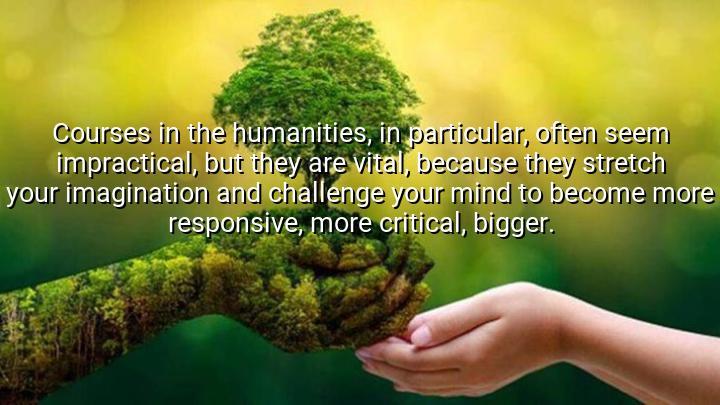




The quote "Courses in the humanities, in particular, often seem impractical, but they are vital, because they stretch your imagination and challenge your mind to become more responsive, more critical, bigger" by Martha Nussbaum speaks to the value of studying the humanities despite the perception that they are not directly applicable to practical careers. Nussbaum argues that while fields like philosophy, literature, history, and the arts may seem disconnected from tangible skills, they are essential because they stimulate the imagination, encourage critical thinking, and foster a broader, more nuanced understanding of the world.
The origin of this quote reflects Nussbaum's long career as a philosopher and scholar. She has written extensively on the importance of the humanities in cultivating a well-rounded, thoughtful individual. Nussbaum believes that the humanities challenge students to think more deeply, question assumptions, and engage with complex ideas. They don't just teach facts; they help shape the way we think, perceive, and engage with society, preparing students to be more thoughtful, open-minded, and intellectually agile.
Nussbaum’s mention of the imagination highlights how the humanities encourage us to envision different perspectives, explore the experiences of others, and think outside of our immediate surroundings. They also promote critical engagement with ideas, encouraging students to not just accept information but to analyze, critique, and interpret it. This process makes one’s thinking more flexible, responsive, and ultimately more expansive—qualities that are crucial for both personal development and broader social engagement.
In essence, Nussbaum’s quote argues that the humanities may not always yield immediate, practical returns, but they cultivate an invaluable set of intellectual and emotional skills. They broaden the mind, strengthen critical thinking, and nurture the imagination, ultimately preparing individuals to navigate the complexities of the world with deeper insight and empathy. The true value of the humanities, then, lies in their ability to foster personal growth and contribute to a more thoughtful, well-rounded society.

AAdministratorAdministrator
Welcome, honored guests. Please leave a comment, we will respond soon