

So long as the system of competition in the production and exchange of the means of life goes on, the degradation of the arts will go on; and if that system is to last for ever, then art is doomed, and will surely die; that is to say, civilization will die.
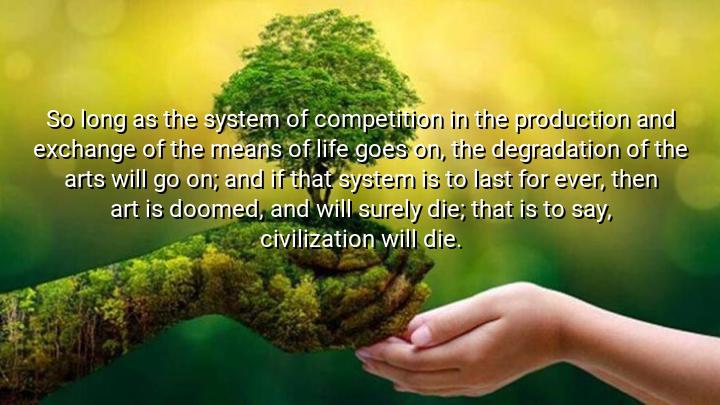




William Morris’s quote, “So long as the system of competition in the production and exchange of the means of life goes on, the degradation of the arts will go on; and if that system is to last for ever, then art is doomed, and will surely die; that is to say, civilization will die,” is a passionate critique of capitalism and its effect on art and culture. Morris argues that as long as economic competition and profit-driven systems dominate society, art will continue to be degraded—stripped of its soul, meaning, and connection to everyday life. For him, the health of civilization is deeply tied to the flourishing of the arts.
As a leading figure of the Arts and Crafts Movement in the 19th century, William Morris was both an artist and a socialist. He believed that mass production, industrialization, and unchecked commercialism were not only dehumanizing workers but also destroying the quality and integrity of artistic creation. In his view, art had once been an integral part of daily life, created by skilled artisans who took pride in their work. But under the system of capitalist competition, art was becoming a commodity, disconnected from the human spirit.
Morris's use of the phrase “degradation of the arts” refers to the decline in both the craftsmanship and purpose of artistic work in a market-driven world. He saw this as a symptom of a deeper societal decay, where aesthetic value is sacrificed for economic efficiency. To him, if this system continues indefinitely, it would not only kill art, but also lead to the collapse of civilization itself, since a society without beauty, meaning, and creative expression cannot truly thrive.
Ultimately, this quote serves as both a warning and a call to action. Morris challenges us to reimagine a world where art and labor are valued not for their profitability, but for their ability to enrich human life. He believed that for civilization to survive and evolve, we must build systems that honor creativity, collaboration, and the intrinsic worth of artistic labor—values that he saw as essential to a just and meaningful society.

PNPhuong Nguyen
This quote raises complex questions about the relationship between economics and aesthetics. If artists must constantly compete for attention and funding, are we selecting for art that’s simply the most palatable or marketable, rather than the most meaningful? What would a world look like where art thrived outside of competition—how would it change our cultural values, or even our understanding of what art is?
LTLuu Tu
I’m struck by the severity of the statement. Is Morris being too idealistic, or was he just ahead of his time in predicting the effects of capitalism on cultural expression? The idea that competition could lead to the death of civilization via the arts is extreme. But in a world where algorithms and marketability drive creation, is he ultimately being proven right?
MNLe My Na
Reading this, I feel a sense of urgency and concern. Is it possible to create a sustainable space for art outside the pressures of the market? Can community-driven, publicly funded art movements be enough to resist the decline Morris warns about? Or is this more of a utopian hope in a world where even creativity often bends to economic survival?
DHDoan Hung
It’s fascinating how this quote connects economic ideology with the survival of civilization itself. Do we underestimate the role of art in maintaining cultural and societal vitality? If art dies, as Morris warns, what replaces it? Propaganda? Mass-produced entertainment? What’s the long-term impact on a society that no longer values or supports non-commercial artistic expression?
QAphan quang anh
Morris draws a very direct line between economic systems and cultural decay, which feels like a bold but compelling claim. It makes me wonder: has the commercialization of art truly diluted its integrity, or has it simply changed its form? Are we nostalgic for a ‘purer’ kind of creativity that may never have existed, or are we witnessing the slow erosion of cultural richness due to profit motives?