

No man is good enough to be another's master.
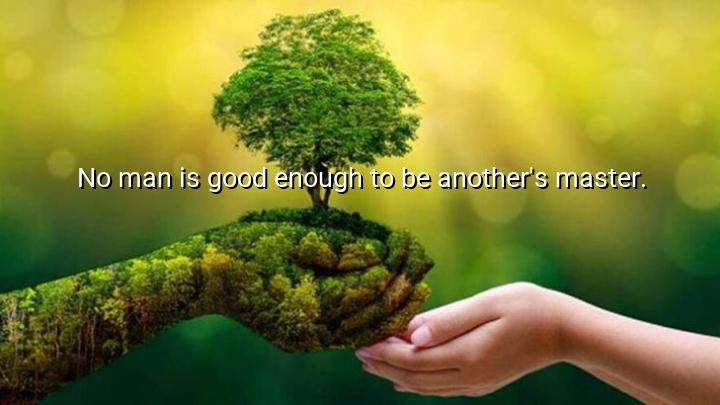




The quote "No man is good enough to be another's master" by William Morris expresses a strong belief in the inherent equality of all individuals. Morris argues that no one is inherently superior or virtuous enough to have the authority to dominate or control another person. It suggests that the idea of one person being a master over another is unjust, as it undermines the principle of individual freedom and autonomy. This quote challenges the structures of power that place one person in a position of dominance over others, advocating instead for equality and mutual respect.
In the context of Morris' work, this quote also aligns with his advocacy for socialism and workers' rights. As a prominent figure in the Arts and Crafts Movement and a social reformer, Morris was critical of the exploitation of workers and the class distinctions that allowed some individuals to exercise control over others. By stating that no man is good enough to be another's master, he champions the idea that social justice should be grounded in equality and solidarity among people, rather than a hierarchical system that benefits a select few.
Morris’ view reflects his commitment to the belief that every person should be able to live freely and with dignity, without being subjugated by others. His quote can be seen as a call to challenge systems of oppression and exploitation, whether they exist in political, economic, or social contexts. It reinforces the notion that freedom and self-determination should be available to all, and that no one should have the power to impose their will over another.
As a writer, artist, and activist, William Morris was deeply involved in advocating for both artistic and social reforms. His views on equality, liberty, and the rights of workers were central to his philosophy. This quote encapsulates his broader belief in the fundamental worth of every individual and his commitment to creating a society that values freedom and justice.

AAdministratorAdministrator
Welcome, honored guests. Please leave a comment, we will respond soon