

Simplicity is natures first step, and the last of art.
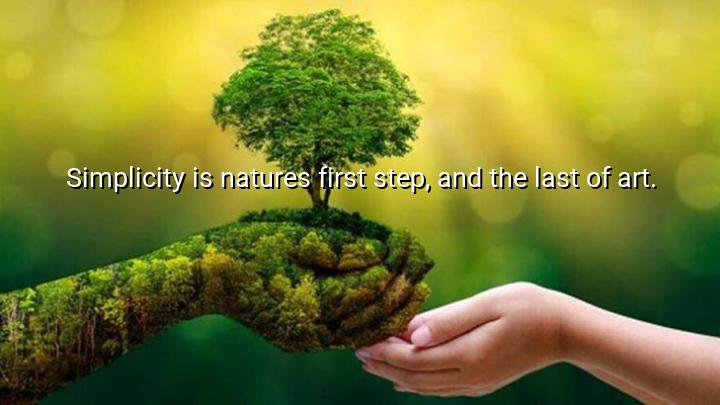




The quote "Simplicity is nature's first step, and the last of art" by Philip James Bailey suggests that simplicity is both a natural and artistic principle. Bailey, an English poet, contrasts the inherent simplicity of nature with the complexity often found in human-created art. He argues that in nature, simplicity is the starting point, with everything existing in its purest, most fundamental form. In contrast, in the realm of art, simplicity is often the final goal, after an artist has experimented and refined their work through layers of complexity and expression.
Bailey’s statement highlights that nature, in its most basic form, is inherently simple. Whether in the structure of a flower, the flow of a river, or the shape of a mountain, nature operates without unnecessary complication. However, as humans attempt to replicate or interpret these natural forms through art, they often begin with complexity—whether in technique, symbolism, or style. Yet, in the end, the greatest works of art return to the simplicity of form and expression, capturing the essence of the natural world in its most pure and refined state.
The idea that simplicity is the last step of art reflects the belief that true artistic mastery involves stripping away excess, focusing on the core message or beauty that an artwork seeks to convey. Rather than overwhelming the viewer with detail, the most impactful art often communicates its message through a clear, simple expression that resonates deeply. This process of distillation is a sign of the artist’s skill and understanding of the subject.
Ultimately, Bailey’s quote emphasizes the cyclical relationship between nature and art, where simplicity is both the beginning of the natural world and the goal of artistic creation. It reminds us that true beauty, both in nature and art, lies in the ability to embrace and express the simple, essential truths of life.

YNHoang Yen Nhi
The quote strikes me as poetic truth. Nature begins with simplicity—seed, cell, atom—yet it evolves into vast, intricate systems. Art does the reverse: it may start complex but ultimately seeks clarity, essence, and form. Do you think this perspective could influence how we teach creativity? Maybe the goal isn’t to make things more detailed but more distilled, more essential.
TTTuyet Mai Tran Thi
This quote has me wondering—if simplicity is both the beginning and the end, what happens in the middle? Is the artistic journey one of learning how to manage complexity only to learn how to discard it? I think there's something philosophical here about the human journey as well. Maybe wisdom is knowing when to add and when to let go.
AVNgoc anh Vu
I find this quote very grounding. It reminds me that the most impactful experiences—whether in nature, design, or poetry—are often the least complicated. But in today's world of over-saturated media and constant stimulation, do we even recognize simplicity when we see it? It almost feels radical to appreciate something understated or quiet. I’d love to know how artists today interpret this idea.
NGNguyen Giang
Is simplicity in art always a sign of maturity or mastery? Sometimes, minimalism can feel empty or lacking depth. How can we tell when simplicity is the result of skill and not just lack of effort or content? I think this quote raises a great question about intention—whether in creating art or observing it. It challenges me to look deeper at what 'simple' really means.
TLDuy Tien Le
I love how this quote bridges nature and art. It suggests a kind of full-circle journey—from the basic to the refined, back to the pure. Do you think modern art embraces this idea, or has it drifted too far into abstraction and complexity? I sometimes feel like we're so focused on innovation that we overlook the power of simplicity to move and inspire us.